

In our clinic, we often see patients who ask whether hormonal contraceptives, menopause treatments, or some gynecological treatments can affect their veins. The correct answer is not a simple “yes” or “no”.
Some hormonal treatments, especially those containing systemic estrogens, may increase the risk of blood clots forming in the veins. In medicine, this is called venous thromboembolic disease, and it mainly includes deep vein thrombosis and pulmonary embolism.
By contrast, the relationship between hormones and the appearance of varicose veins, spider veins, or chronic swelling is more complex. There may be a hormonal influence, symptoms may worsen in some women, and there is a plausible biological basis, but the scientific evidence does not allow us to state with the same strength that contraceptives or hormonal treatments “cause varicose veins” by themselves: rather, it seems that varicose veins or spider veins that have started for other reasons (genetic factors, for example) may “accelerate” in the presence of these hormonal treatments.
That is why it is important to separate two ideas:
- One thing is to notice more leg heaviness, swelling, or sensitivity when starting hormonal treatment.
- Quite another is to develop a thrombosis, which can be a potentially dangerous situation and requires medical assessment.
This article aims to explain clearly what is currently known, which warning signs should not be ignored, and when it may be useful to consult a vascular surgeon.
Contents
- How veins work and why clots can be dangerous
- Which hormonal treatments can affect the veins?
- Combined hormonal contraceptives: not all pills are the same
- Progestogen-only contraceptives: generally more favorable, but not all the same
- Hormone therapy in menopause: the route of administration matters a great deal
- Hormones, varicose veins, and spider veins
- The role of venous Doppler ultrasound
- When can these effects be dangerous?
- Warning signs: when to seek urgent medical attention
- General preventive measures to care for your veins
- Do not stop hormonal treatments on your own
- When to consult a vascular surgeon
- Hormonal treatments and varicose vein procedures
- Conclusion
- FREQUENTLY ASKED QUESTIONS
How veins work and why clots can be dangerous
Veins are the vessels that return blood from the legs to the heart. In the lower limbs, this work is especially demanding because blood has to move upward against gravity.
To achieve this, veins rely on several mechanisms: venous valves, contraction of the calf muscles while walking, and a deep system that carries most of the venous return. When these mechanisms fail or become overloaded, symptoms such as heaviness, tiredness, swelling, or varicose veins may appear.
The problem becomes more serious when we talk about a thrombus, that is, a clot inside a vein.
There are two main situations:
Superficial venous thrombosis
It is also often called phlebitis. It affects veins closer to the skin. It may appear on a varicose vein or on a healthy vein, causing pain, redness, local warmth, and a hard cord under the skin. Traditionally it was considered a minor problem, but today we know that it should not always be trivialized, because in some cases it may be associated with, or progress toward, deep veins.
Deep vein thrombosis
It affects the deep venous system. It is more important because a fragment of the clot may travel to the lungs and cause a pulmonary embolism. This situation can be serious.
Which hormonal treatments can affect the veins?
Not all hormonal treatments have the same effect on the venous system. The risk depends on several factors: type of hormone, dose, route of administration, age, personal history, smoking, obesity, immobilization, recent surgery, pregnancy, cancer, thrombophilias, or family history.
The treatments that most often raise questions include:
- Combined hormonal contraceptives, which contain estrogen and progestogen.
- Progestogen-only contraceptives.
- Hormonal treatments for menopausal symptoms.
- Hormonal treatments used for endometriosis, abnormal uterine bleeding, or other gynecological indications.
- Low-dose vaginal estrogens, when used for genitourinary symptoms of menopause.
The key point is that the risk is not the same in every case.

Combined hormonal contraceptives: not all pills are the same
Combined contraceptives contain an estrogen and a progestogen. This is the group most clearly associated with an increased risk of venous thrombosis.
This does not mean that every woman taking combined contraceptives will develop a thrombosis. In fact, in young and healthy women the absolute risk is usually low. But it does mean that the risk is higher than in women who do not take them, and that the individual context should be assessed.
In addition, not all formulations have the same profile. Current evidence indicates that the risk may vary depending on the estrogen dose and the type of progestogen. Some formulations have a lower relative risk profile, while others have a higher one.
In practice, this reinforces an important idea: the choice of contraceptive should not be based only on convenience or cycle regularity. It should also take into account each patient’s vascular risk factors.
Progestogen-only contraceptives: generally more favorable, but not all the same
Progestogen-only methods are usually considered safer from a venous point of view than combined contraceptives with estrogens. This group includes, among others, some mini-pills, implants, hormonal intrauterine devices, and injectable preparations.
Even so, they should not all be put in the same category. Some progestogens with low systemic exposure or a more local action have a more favorable venous profile. By contrast, certain injectable preparations or progestogens used at high therapeutic doses may require more caution, especially if there is a history of thrombosis, thrombophilia, or several accumulated risk factors.
For this reason, if a patient has relevant vascular history, it may be advisable for the gynecologist and vascular specialist to assess together which hormonal alternative is more reasonable.
Hormone therapy in menopause: the route of administration matters a great deal
In menopause, the most important change in recent years has been understanding that it is not only a matter of “taking hormones or not”, but which hormone is used, at what dose, and by which route.
Oral menopausal hormone therapy has been associated with a higher venous risk, especially in women with thrombotic risk factors. By contrast, the transdermal route, such as some patches or gels, appears to have a more favorable thrombotic profile.
This does not mean that every woman should use hormone therapy, nor that the transdermal route is suitable for every case. It means that, when hormone therapy is indicated and there are venous risk factors, the route of administration should be part of the medical discussion.
It is also important to distinguish systemic treatments from local treatments. For example, low-dose vaginal estrogens, used for genitourinary symptoms, have much lower systemic absorption and should not be assessed in the same way as systemic hormone therapy.
Hormones, varicose veins, and spider veins
A common question is whether hormones cause varicose veins or spider veins. The prudent answer is:
- They may influence venous symptoms in some women (for example, increasing leg heaviness).
- It has not been demonstrated with the same strength that they cause primary varicose veins or spider veins by themselves.
- They do appear to accelerate the rate of appearance or growth of varicose veins or spider veins that have already begun to develop for other reasons.
Varicose veins usually depend on many factors: family predisposition, age, pregnancies, obesity, jobs that involve many hours standing or sitting, sedentary lifestyle, changes in the venous wall, and valve function. Hormones may participate in some mechanisms, but they are not the only factor and not necessarily the main one.
In our clinic, we often see that some women notice more heaviness, swelling, or a sensation of tired legs when starting certain hormonal treatments. This may be due, in part, to fluid retention or to changes in how venous symptoms are perceived.
But if a patient develops visible varicose veins, pain, persistent swelling, or skin changes, it is not enough to attribute everything to hormones. It is advisable to investigate whether there is venous insufficiency or another associated problem.
The role of venous Doppler ultrasound
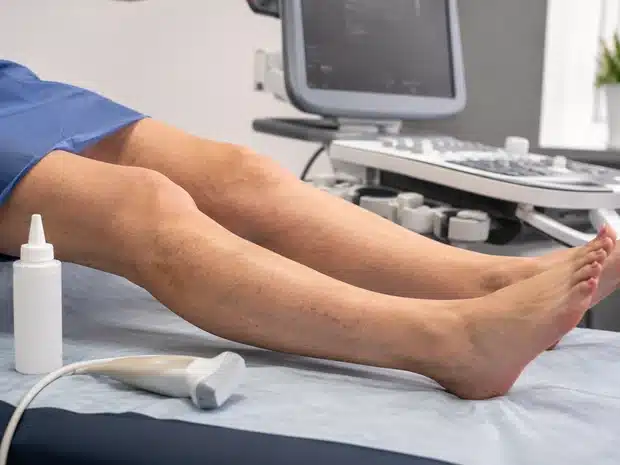
When there are persistent venous symptoms, visible varicose veins, swelling of one leg, suspected thrombosis, or a history of phlebitis, it is necessary to study venous circulation in the limbs by performing a venous Doppler ultrasound.
Doppler ultrasound makes it possible to assess how blood flows through the veins, whether there is venous reflux, whether the valves work correctly and, in certain contexts, whether there is venous thrombosis, either superficial or deep.
Not every patient taking contraceptives or hormonal treatments needs a Doppler ultrasound. But it is needed when there are symptoms, varicose veins, a history of thrombosis, or doubts before considering venous treatment.
At Clínica Vascular Dr. Jorge Molina, in Valencia, this assessment helps differentiate very different situations: from functional venous discomfort to varicose veins with reflux or clinical pictures that require more urgent action.

When can these effects be dangerous?
The most important risk is not the appearance of a spider vein, but the possibility of deep vein thrombosis or pulmonary embolism.
There are situations in which the use of systemic estrogens may be especially delicate:
- Personal history of deep vein thrombosis or pulmonary embolism.
- Previous thrombosis related to contraceptives, pregnancy, or hormonal treatment.
- Known thrombophilia.
- Active cancer.
- Major surgery or prolonged immobilization.
- Significant obesity.
- Smoking, especially after a certain age.
- Relevant family history of thrombosis.
- Current or previous superficial venous thrombosis.
- Prolonged travel with little movement (for example, long flights).
- A combination of several risk factors.
An important practical point: isolated varicose veins do not automatically mean that hormonal contraception is contraindicated. However, having had superficial venous thrombosis, deep thrombosis, or several accumulated risk factors does change the assessment.
Warning signs: when to seek urgent medical attention
There are symptoms where it is not advisable to wait and see “if they go away”. You should seek urgent medical assessment if any of the following appear:
- Swelling of one leg, either sudden or progressive.
- Severe pain in a calf or thigh, especially if accompanied by increased volume.
- Redness, warmth, and pain along the course of a vein.
- A feeling of shortness of breath.
- Chest pain.
- Coughing up blood.
- Severe dizziness, syncope, or a feeling of fainting.
- Sudden worsening of venous symptoms after starting hormonal treatment, especially if it is unilateral.
These signs do not always mean there is a thrombosis, but they do justify ruling it out.
General preventive measures to care for your veins
Preventive measures do not replace medical assessment when there is risk, but they may help improve venous return and reduce discomfort in many people.
Stay active
Walking, swimming, cycling, or doing moderate exercise supports the work of the calf muscles, which act as a natural “pump” to help blood move upward toward the heart.

If you work many hours sitting or standing, try to get up, walk, or move your ankles frequently.
Avoid prolonged immobilization
Long journeys, periods of rest, or very sedentary days may slow venous return. In people with risk factors, it is advisable to discuss with the doctor which measures are appropriate during long trips or before surgery.

Control weight
Overweight and obesity increase pressure on the venous system of the legs and may worsen heaviness, swelling, and the progression of venous disease.
Avoid tobacco
Tobacco adds cardiovascular risk and may increase risk in women using certain hormonal treatments, especially combined contraceptives.
Use compression stockings when indicated
Compression stockings can be very useful in patients with venous symptoms, varicose veins, jobs involving many hours standing, or certain risk situations. But not all stockings are the same. The appropriate type, size, and degree of compression should be indicated individually.

Avoid excessive direct heat
Heat promotes vasodilation and may increase the feeling of heaviness, swelling, or tiredness in the legs. Saunas, prolonged sun exposure, or direct heat sources may worsen symptoms in predisposed people.
Stay hydrated and move during long trips
During long trips, it is advisable to get up if possible, move your ankles, walk during breaks, maintain adequate hydration, and avoid remaining immobile for many hours. In people with high thrombotic risk, these measures should be individualized.
Do not stop hormonal treatments on your own
This point is essential. If you are taking contraceptives, hormone therapy for menopause, or medication for a gynecological indication, it is not advisable to stop it without speaking to your doctor.
The decision must balance benefits and risks. Sometimes it will be enough to adjust the type of treatment, change the route, consider alternatives without estrogens, or reinforce preventive measures. In other cases, it may be necessary to avoid certain hormonal treatments.
When to consult a vascular surgeon
It may be advisable to request assessment by a vascular surgeon if:
- You have visible varicose veins and are going to start, or are already taking, hormonal treatment with estrogens.
- You have had phlebitis (superficial venous thrombosis), deep thrombosis, or pulmonary embolism.
- You have an important family history of thrombosis.
- You have persistent swelling of one leg.
- You notice pain, warmth, redness, or a hard cord over a vein.
- You have heaviness, tiredness, or swelling that worsens throughout the day.
- You are considering varicose vein treatment, sclerotherapy, or a venous procedure and you take contraceptives or hormone therapy.
- You are unsure whether your symptoms are venous, hormonal, or due to another cause.
In these cases, the aim of the consultation is not to alarm or automatically prohibit treatments. The aim is to assess the real risk, study the veins when appropriate, and coordinate the best decision with the other specialists involved.
Hormonal treatments and varicose vein procedures
If a patient takes combined contraceptives or hormone therapy and is going to undergo sclerotherapy, radiofrequency, VenaSeal®, or another venous procedure, the assessment should be individualized.
The thrombotic risk of venous procedures is usually low, but it is not zero. For this reason, it is advisable to take into account a history of thrombosis, obesity, immobilization, cancer, thrombophilia, type of hormone, and the extent of the procedure.
It will not always be necessary to stop hormonal treatment, but it should not be ignored as if it had no influence. The decision should be made case by case.
Conclusion
Contraceptives and other hormonal treatments may influence venous health, but they do not all do so in the same way. The best-demonstrated effect is the increased risk of venous thrombosis with certain treatments containing systemic estrogens, especially combined contraceptives and oral hormone therapy.
By contrast, the relationship with varicose veins, spider veins, or chronic swelling is less direct. It is true that symptoms may worsen in some women. And also, once varicose veins or spider veins begin to form for other reasons, hormonal treatments seem to accelerate this process.
The key is to individualize: understand the risk factors, not trivialize warning symptoms, and seek consultation when there is a history or signs suggestive of venous disease.
The information in this article is general and does not replace a personalized medical assessment. If you have symptoms, a history of thrombosis, or questions about your hormonal treatment, consult a healthcare professional.
FREQUENTLY ASKED QUESTIONS
Do contraceptives cause clots in the legs?
Some combined hormonal contraceptives may increase the risk of venous thrombosis. The risk depends on the type of preparation and each woman’s personal factors. In young and healthy women, the absolute risk is usually low, but it is not the same for everyone.
Does having varicose veins mean I cannot take hormonal contraceptives?
Not necessarily. Isolated varicose veins do not automatically amount to a contraindication. The important thing is to assess overall risk: history of thrombosis, previous superficial thrombosis, smoking, obesity, age, immobilization, surgery, or family history.
Is menopause hormone therapy dangerous for the veins?
Oral hormone therapy may increase venous risk in certain women. The transdermal route usually has a more favorable thrombotic profile, especially when risk factors are present. The indication should be individualized with the doctor.
Can hormones cause spider veins to appear?
The relationship is not demonstrated with the same strength as the risk of thrombosis. Some women may notice worsening symptoms or changes in the venous terrain. Once varicose veins or spider veins begin to form for other reasons, hormonal treatments seem to accelerate this process.
What should I do if one leg swells while taking contraceptives?
If the swelling is in one leg only, appears suddenly, progresses, or is accompanied by pain, warmth, redness, or shortness of breath, you should seek urgent medical advice to rule out thrombosis.
Can I have sclerotherapy if I take contraceptives?
It depends on the case. It is not always contraindicated, but the individual thrombotic risk should be assessed before the procedure, especially if there is a history of thrombosis, phlebitis, obesity, thrombophilia, or immobilization, because it may be increased.
Should you be interested in getting to know this disease better, and its causes, consequences, how to treat them, and, even better, what can we do to prevent them, you can find it all well explained in the ebook VARICOSE VEINS: Truth & myths.