
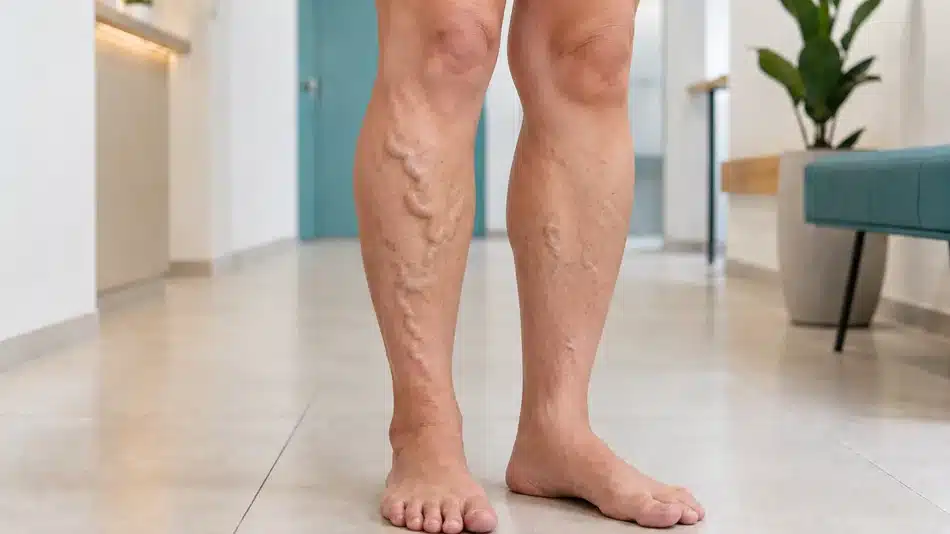
Varicose veins are enlarged, twisted superficial veins that develop when blood no longer returns properly from the legs to the heart. They are very common and, although they may sometimes be a concern only because of their appearance, they can also cause heaviness, pain, swelling and complications if venous insufficiency progresses.
There are many misconceptions about varicose veins: that exercise alone can eliminate them, that they always lead to thrombosis, or that there is a single definitive treatment for every patient. On this page, we will separate established facts from these myths and explain in clear language what varicose veins are, why they develop, how they are assessed and which treatment options are available today.
Contents
What are varicose veins?
The veins in the legs carry blood from the feet back to the heart. To do this, they contain valves that help blood flow upwards against gravity. When these valves do not close properly, some blood flows backwards and the pressure inside the superficial veins rises. Over time, the veins may enlarge, lengthen and become twisted: this is what we call varicose veins.
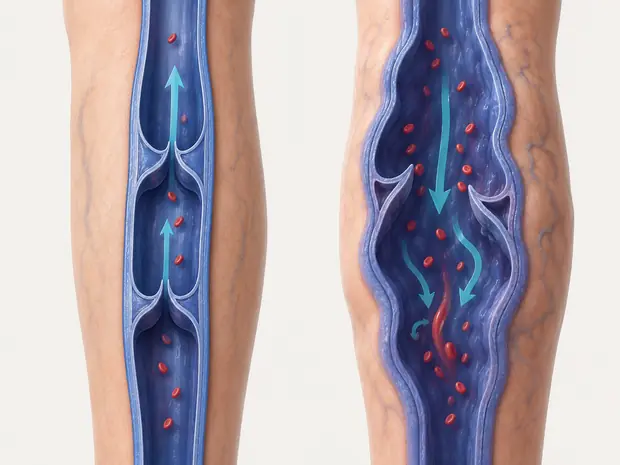
Chronic venous insufficiency is the functional problem underlying many varicose veins. It does not mean that circulation throughout the body is impaired; rather, the venous system in a limb is not returning blood efficiently enough. Visible varicose veins are one manifestation, but symptoms or skin changes may also occur.
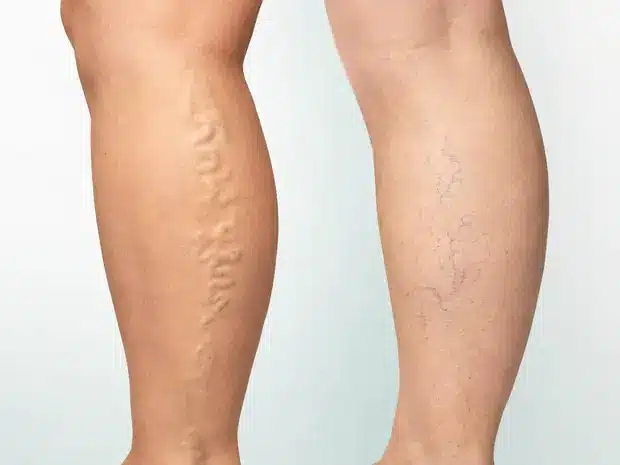
It is important to distinguish them from spider veins. Varicose veins are generally larger, raised and palpable. Reticular veins and telangiectasias are much smaller reddish, bluish or greenish vessels that, in most cases, are mainly a cosmetic concern. A leg may have both types at the same time, but they are not diagnosed or treated in the same way.
Why they develop: causes and risk factors
It is not always possible to identify the underlying reason why venous valves begin to fail. We do know that there is an inherited predisposition: having relatives with varicose veins increases the likelihood of developing them, although it does not predict when they will appear or how severe they will be.
Hormonal factors and situations such as pregnancy also play a role, as pregnancy combines hormonal changes, increased blood volume and greater pressure within the abdomen. Age contributes to a loss of elasticity in the vein walls, but varicose veins are not limited to older people.
Standing still or sitting for many hours makes venous return more difficult because it reduces the action of the calf muscles. A sedentary lifestyle, excess weight and obesity can make this worse. Heat dilates the veins and often intensifies symptoms, although it is not by itself the cause of the condition.
These factors do not affect everyone in the same way. Someone with a strong predisposition may develop varicose veins despite leading an active life, while another person who has worked standing up for years may never develop them. Prevention can therefore help reduce symptoms and slow progression, but it cannot provide an absolute guarantee.
Symptoms and what may happen if they are not treated
Varicose veins may cause no discomfort, or they may produce heaviness, tiredness, tightness, pain, itching and cramps, often worse at the end of the day, in hot weather or after remaining still for many hours. These symptoms do not always come from the veins: muscular, joint or neurological problems can cause similar sensations, so it is important to establish their origin.
When venous pressure rises, leg swelling or oedema may develop, particularly around the ankles. If venous insufficiency progresses over many years, the skin may become inflamed, hardened or brownish. In advanced stages, venous ulcers may develop, especially near the ankle.
Another possible complication is superficial phlebitis or thrombophlebitis in a varicose vein: a blood clot forms inside a superficial vein, which may become painful, red and hard to the touch. Prompt assessment is important to confirm the diagnosis, determine its extent and, above all, start treatment to stop it progressing as soon as possible.
Primary varicose veins have not been shown to cause deep vein thrombosis. They are different conditions. In fact, a previous deep vein thrombosis can damage the valves and subsequently lead to secondary varicose veins and post-phlebitic or post-thrombotic syndrome. Sudden swelling in one leg, severe pain, shortness of breath or chest pain requires urgent medical assessment.
The course varies: not all varicose veins worsen at the same rate and not all require an immediate procedure. However, skin changes, persistent swelling, phlebitis or an ulcer indicate that the condition warrants specialist assessment.
What all varicose veins have in common is that they cannot improve on their own: at best, they may remain unchanged for a time, but their natural tendency is to enlarge or develop new branches over the years if they are not treated.
How varicose veins are diagnosed
Diagnosis begins with a medical history and examination of the legs, but looking at the veins externally is not enough to understand what is happening beneath the surface. The key test is a venous Duplex Ultrasound, a non-invasive scan that shows the anatomy of the veins and assesses the direction and speed of blood flow.
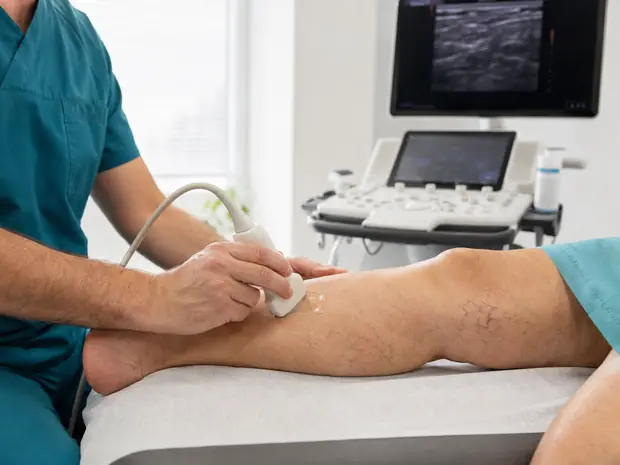
A Duplex Ultrasound identifies sites of reflux, checks the deep venous system and distinguishes primary varicose veins from those secondary to other problems. This information helps determine whether conservative treatment is sufficient or whether a procedure should be considered to close or remove certain veins. Choosing a technique without this map beforehand risks treating only what is visible without understanding the underlying functional cause.
Treatments available today
There is no single treatment that is best for everyone. The choice depends on the type and size of the varicose veins, the path of reflux through their connections, the symptoms, the medical history and the patient’s preferences. The aim is not simply to erase a visible vein, but to address the abnormal venous circuit identified by the Duplex Ultrasound in a considered way.
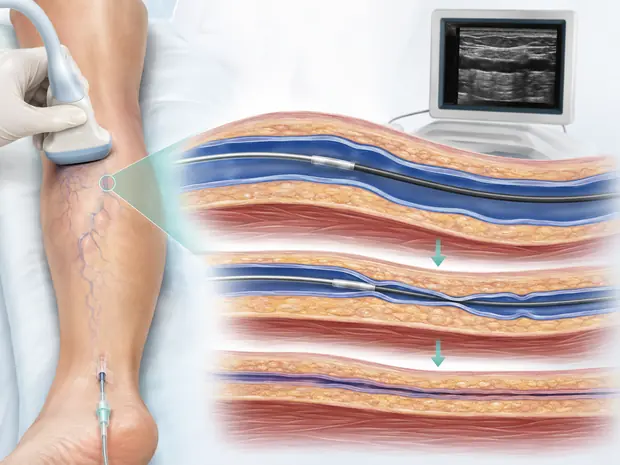
VenaSeal®. This non-thermal technique uses a catheter, under ultrasound guidance, to deliver a small amount of medical adhesive and close the insufficient vein. It does not require heat to be applied around the vein and, in suitable cases, patients can return to their normal daily activities almost immediately.
Radiofrequency ablation. This is also performed using an ultrasound-guided catheter. In this case, controlled thermal energy is applied inside the vein to close it. It is a well-established, effective minimally invasive technique when appropriately indicated. It requires local anaesthetic around the treated vein, and recovery is usually much more comfortable and faster than after traditional surgery, generally taking only a few hours.
Endovenous laser treatment, This is very similar to radiofrequency ablation, based on the same principles and with very similar indications and outcomes. The main difference is how the heat used to close the varicose vein is generated.
Sclerotherapy. This involves injecting a sclerosing agent to close small vessels. At this clinic, it is used mainly for spider veins and reticular veins, rather than as a substitute for treating large varicose veins. It usually requires several sessions and cannot guarantee a perfect cosmetic result or prevent new vessels from appearing over time.
Traditional surgery, or saphenectomy, removes the diseased vein and still has specific indications. However, it is generally more invasive and recovery is slower than with modern endovenous techniques, so we usually reserve it for varicose veins whose anatomy does not allow us to use one of the newer techniques.
The CHIVA strategy and Müller phlebectomy are different options: CHIVA aims to preserve veins by altering haemodynamics, although its recurrence rate may be among the highest; phlebectomy removes varicose branches through very small incisions and can be used for limited varicose veins or alongside one of the techniques described above.
It is important to emphasise that no existing technique is suitable for every anatomy or can guarantee that other veins will not become diseased in the future. At present, we cannot change a person’s genetic tendency to develop varicose veins or spider veins, so we recommend regular follow-up afterwards.
Conservative treatments may relieve symptoms and help slow progression, but they cannot make an established varicose vein disappear. These include phlebotonics or venotonics, which are generally not very effective; lifestyle and postural measures, such as walking, avoiding prolonged periods of immobility, managing weight and limiting heat exposure; and compression stockings, which are particularly useful for controlling symptoms when the correct style, size and pressure have been prescribed.
And one very important point: the newest technique is not necessarily the best for everyone. What matters is that the recommendation follows a complete assessment by a specialist in Angiology and Vascular Surgery who is experienced in several alternatives.
What happens at the first appointment
At our One-Stop Consultation, Dr Molina personally takes your medical history, examines you and performs the venous Duplex Ultrasound. With all this information, he will explain the exact diagnosis and suggest the most reasonable treatment options for your individual case. He will then provide the necessary information both verbally and in writing, so that you can make your decision without pressure.
There are also no waiting lists: we can usually see you within no more than one week, except during holiday periods.
Everything is assessed and decided in a single appointment, but treatment is not carried out that same day. It begins at a later visit, after you have had as much time as you need to consider it.
This offers another advantage: you choose, together with Dr Molina, the day on which you would like to have the treatment, again without waiting lists, uncertainty or other constraints.
Seeing a vascular surgeon with specific expertise who is proficient in several different techniques makes it possible to compare benefits, limitations and alternatives without assuming that every varicose vein requires the same technique.
FREQUENTLY ASKED QUESTIONS
Are varicose veins only a cosmetic concern, or are they also a health problem?
Varicose veins are not merely a cosmetic concern. They may cause no discomfort in some people, but in others they can produce heaviness, pain, itching, cramps and swelling. If venous insufficiency progresses, skin changes, superficial phlebitis and, in advanced stages, venous ulcers may develop. Small spider veins, by contrast, are usually mainly a cosmetic issue.
Can varicose veins be cured permanently?
Diseased veins can be closed or removed with effective treatments, but the predisposition that caused them to become diseased cannot always be corrected. It would therefore be misleading to promise that new varicose veins will never appear. Proper assessment, appropriately selected treatment and follow-up help control the condition and treat any recurrence if it occurs.
Can exercise or compression stockings cure varicose veins?
Exercise activates the calf muscles and compression stockings assist venous return, so both may reduce symptoms and slow progression. However, they cannot make an established varicose vein disappear. Stockings must be selected with the appropriate size, length and level of compression for each person.
What is the best treatment for varicose veins today?
There is no single technique that is best for every patient. VenaSeal® and radiofrequency ablation are important minimally invasive options for certain patterns of venous reflux; sclerotherapy is used mainly for spider veins and reticular veins. The choice depends on each patient’s anatomy, symptoms, medical history and the findings of the venous Duplex Ultrasound.
Do current treatments require surgery and a hospital stay?
Many modern treatments, such as VenaSeal® or radiofrequency ablation, are performed as outpatient procedures and do not require a hospital stay. Traditional surgery may require more complex anaesthesia and, in some cases, admission to hospital, although we increasingly reserve it for patients whose venous anatomy does not allow one of the newer procedures. The specific requirements depend on the technique and each patient’s clinical situation.
How long does recovery take after a modern varicose vein treatment?
Recovery depends on the technique, the extent of treatment, the type of work and the individual patient’s characteristics. After minimally invasive procedures, it is usually possible to walk straight away and return to everyday activities the same day, but the same timeframe should not be assumed for everyone. The specialist will explain any necessary restrictions and follow-up appointments.
When should you be concerned and see a specialist?
You should seek advice if varicose veins cause pain, persistent heaviness, swelling, itching, changes in skin colour or hardening, bleeding, a wound that does not heal, or a painful red cord. Sudden swelling in one leg, shortness of breath or chest pain requires urgent medical attention.
Should you be interested in getting to know this disease better, and its causes, consequences, how to treat them, and, even better, what can we do to prevent them, you can find it all well explained in the ebook VARICOSE VEINS: Truth & myths.