

Varicose veins are the most common vascular disease in adults. Although many people associate them only with a cosmetic concern, they can cause symptoms such as leg heaviness, tired legs, swelling, warmth, itching, or discomfort that worsens toward the end of the day. In some cases, they may also lead to complications such as superficial thrombosis, skin changes, or venous ulcers.
Fortunately, the treatment of varicose veins has evolved remarkably over recent decades. Traditional surgery, which for many years was the reference option, has gradually given way to less invasive techniques that make it possible to treat venous insufficiency with a much faster recovery and less trauma for the patient.
One of these techniques is endovenous radiofrequency ablation, a procedure that has been part of the therapeutic options in modern vascular surgery for years and is now considered one of the most widely used options for certain types of venous insufficiency.
However, it is important to make one point clear from the beginning: radiofrequency is not a universal solution for all varicose veins. As with any medical treatment, the indication must be individualized and based on an appropriate prior assessment.
Contents
- What varicose veins are and why they appear
- The importance of venous Doppler ultrasound
- What radiofrequency is
- How radiofrequency works
- How the procedure is performed
- Is it a surgical procedure?
- What advantages radiofrequency offers
- What the patient can expect afterward
- Is radiofrequency better than other treatments?
- Can all varicose veins be treated with radiofrequency?
- Does radiofrequency eliminate varicose veins permanently?
- When can radiofrequency be considered?
- The importance of personalizing treatment
- Medical assessment before deciding on treatment
- FREQUENTLY ASKED QUESTIONS
What varicose veins are and why they appear
To understand how radiofrequency works, we first need to understand what happens when varicose veins develop.
The veins in the legs carry blood back toward the heart. To do this, they have internal valves that allow blood to flow upward but prevent it from flowing back down under the effect of gravity.
When these valves stop working properly, some of the blood begins to flow backward and pool in certain veins. This is known as venous reflux. Over time, pressure inside the vein increases, the vein wall gives way, it dilates, and varicose veins appear.
Not everyone has the same pattern of venous disease. Some people develop small spider veins, while others have insufficiency of the saphenous veins, which are the main superficial veins of the leg.
For this reason, before considering any treatment, it is essential to know exactly which veins are affected and how blood is flowing in each case.
The importance of venous Doppler ultrasound
In our clinic, we often see patients who ask directly about a specific technique: radiofrequency, VenaSeal®, sclerotherapy, or another option they have read about online. However, the correct order is precisely the opposite: first we need to study the venous system, and only then decide which treatment may be most appropriate.
The essential tool for this is venous Doppler ultrasound. This examination allows us to assess how the veins work in real time, identify the origin of venous reflux, and determine which segments are affected.
With Doppler ultrasound, we can answer essential questions:
- Is venous insufficiency really present?
- Which veins show reflux?
- What is the course of the diseased vein?
- Is there any relevant anatomical variation?
- Is it possible to perform an endovenous treatment?
- Which technique may best suit this specific case?
Without this information, any treatment decision would be incomplete.
What radiofrequency is
Radiofrequency is a form of endovenous thermal ablation. This means that the vein is treated from the inside using controlled heat to close it.
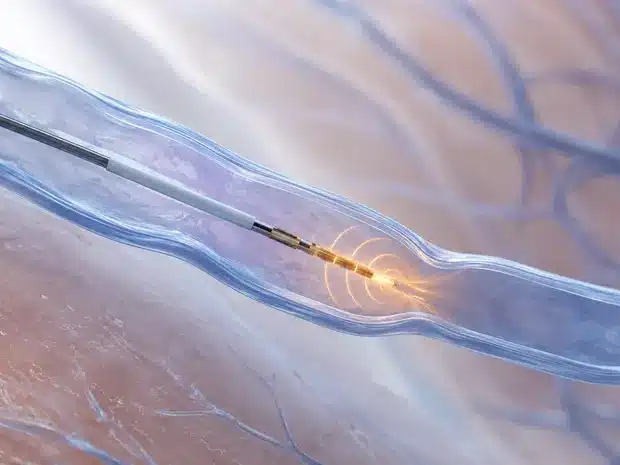
The aim is not to remove the vein or physically take it out during the procedure. The goal is to deactivate the insufficient vein so that it no longer contributes to venous reflux.
Afterward, the body gradually transforms that vein into a scar-like cord, which is partially reabsorbed over time.
The technique is one of the minimally invasive procedures that have replaced conventional surgery in many cases. Major international clinical guidelines consider endovenous ablation one of the reference treatment options for patients with properly assessed saphenous vein insufficiency.
How radiofrequency works
Radiofrequency energy generates controlled heat in the inner wall of the vein. When the temperature reaches the appropriate level, proteins in the vein wall undergo a change that causes the vessel to contract and close.
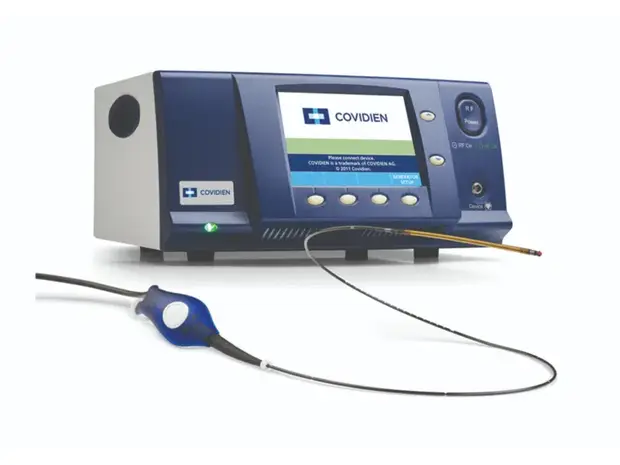
In this way, blood stops flowing through the diseased vein and is redirected toward other healthy veins that can take over venous return.
It is important to understand that the treated vein is not necessary for normal circulation in the leg. The veins selected are precisely those that have stopped functioning properly and are contributing to the problem.
How the procedure is performed
Radiofrequency is usually performed as an outpatient procedure. After preparing the limb and carrying out a new ultrasound check, the vein is accessed through a puncture.
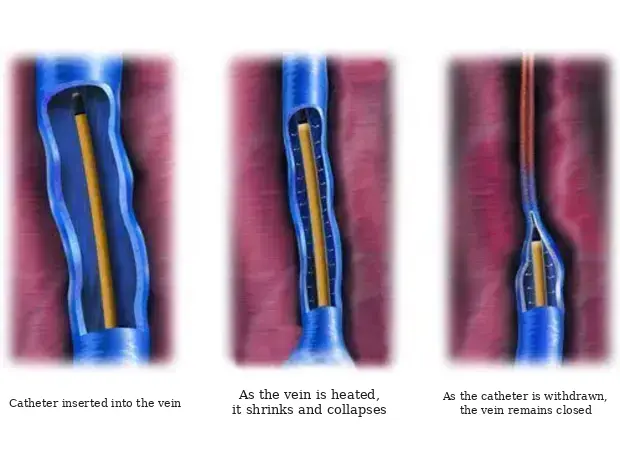
Through this puncture, a very fine catheter is introduced and advanced inside the vein to the desired position. The entire procedure is carried out under continuous ultrasound guidance, allowing the vein to be visualized, the exact position of the catheter to be confirmed, and each step of the treatment to be monitored.
Once it is correctly positioned, local anesthesia is administered around the vein. This detail is important because it distinguishes radiofrequency from other non-thermal techniques.
Tumescent anesthesia has several functions:
- It reduces discomfort.
- It protects the surrounding tissues from heat.
- It compresses the vein around the catheter.
- It improves the effectiveness of the procedure.
The radiofrequency system is then activated, and the vein is treated progressively as the catheter is withdrawn in a controlled manner. At the end, the catheter is removed and the puncture site is covered.
In most cases, the patient can get up and start walking about one hour after the procedure.
Is it a surgical procedure?
Technically, it is an interventional medical procedure, but the patient experience is very different from traditional surgery.
- It does not require incisions or stitches: because it is performed through a simple puncture, it is not very different from inserting an intravenous line for a saline drip.
- The vein is not physically removed.
- The impact on the tissues is much lower than with classic saphenectomy techniques.
For this reason, patients usually experience a much faster recovery and an earlier return to their usual activities.
What advantages radiofrequency offers
Radiofrequency has become popular because it brings together several features that are attractive for both patients and specialists. Its possible advantages include the following.
Minimally invasive procedure
The technique is performed using a puncture and a catheter, avoiding the larger incisions typical of conventional surgery.
Continuous ultrasound guidance
The entire treatment is performed under direct visualization with ultrasound. This provides precision and allows the procedure to be adapted to each patient’s anatomy.
Usually fast recovery
Most patients can walk just one hour after the procedure, always following their specialist’s instructions.
Less tissue trauma
By acting from inside the vein, trauma to the surrounding tissues is reduced.
Broad clinical experience
Radiofrequency has been used for years in the treatment of venous insufficiency and has an important base of scientific evidence.
What the patient can expect afterward
One of the most frequent questions is what recovery will be like. The answer depends on several factors:
- Extent of the venous disease.
- Number of veins treated.
- Additional procedures performed.
- Individual patient characteristics.
During the first few days, it is possible to notice some tightness, mild discomfort, or small bruises. These symptoms are usually part of the normal course after the procedure, although each case should be assessed individually.
It is important to follow the vascular surgeon’s recommendations regarding physical activity, follow-up appointments, and aftercare.
Is radiofrequency better than other treatments?
This is probably the most common question, and also one of the most difficult to answer. The reality is that there is no perfect technique for every patient.
In medicine, when several options continue to be widely used, it usually means that each has advantages and disadvantages depending on the clinical situation. Radiofrequency is an excellent tool when there is an appropriate indication.
However, there are also other alternatives, such as:
- VenaSeal®.
- Sclerotherapy.
- Endovenous laser ablation.
- Conventional surgical techniques.
- Other specific procedures depending on venous anatomy.
The choice should be made after an individualized assessment and a detailed explanation of the different options available.
Can all varicose veins be treated with radiofrequency?
NO. This is one of the most common misconceptions we find online.
Radiofrequency is especially aimed at treating certain insufficient venous trunks, but not all varicose veins have the anatomical characteristics required.
Some veins may benefit from other techniques. In other cases, several procedures are combined to obtain a more complete result. That is why a prior Doppler ultrasound study is so important.
Does radiofrequency eliminate varicose veins permanently?
Chronic venous disease is a complex condition. When we treat an insufficient vein, the aim is to correct the problem identified at that time.
However, the venous system continues to evolve over the years. Factors such as genetics, aging, pregnancies, hormonal changes, or certain habits may influence the appearance of new varicose veins in the future.
For this reason, it is more accurate to speak of treating the insufficient veins that have been detected than of absolute guarantees or permanent lifelong results.
When can radiofrequency be considered?
Radiofrequency may be considered in patients who have:
- Symptomatic varicose veins.
- Documented venous insufficiency.
- Venous reflux demonstrated by Doppler ultrasound.
- Anatomy favorable for the procedure.
The final decision should always be made after a complete medical assessment and an individualized explanation of the different alternatives available.
The importance of personalizing treatment
Technological progress has provided specialists with multiple tools to treat venous disease. However, having more options does not mean that there is one single solution suitable for everyone.
In our clinic, we often see patients who are convinced they need a specific technique because they have seen it advertised or know someone who had it. The reality is that every venous system is different. Quite often, even in the same patient, the venous system in the right lower limb differs from that in the left.
That is why the aim should not be to find the newest or most popular treatment, but the one that best fits each patient’s characteristics. After all, today we personalize practically every aspect of our daily lives. It is logical that we should also personalize the treatment of our varicose veins.
Medical assessment before deciding on treatment
If you have varicose veins or symptoms of venous insufficiency and want to know which treatment options may best suit your case, an assessment by a vascular surgeon and a venous Doppler ultrasound make it possible to plan the most appropriate approach.
General information. This article is for informational purposes and does not replace an individualized medical consultation.
FREQUENTLY ASKED QUESTIONS
Is radiofrequency suitable for all varicose veins?
NO. The indication depends on the type of venous insufficiency, the anatomy of the affected veins, and the result of the venous Doppler ultrasound.
Is a Doppler ultrasound needed before treatment?
YES. It is an essential tool for correctly diagnosing the problem and planning any venous procedure.
Is anesthesia used?
Local anesthesia is usually used around the treated vein, and sedation may be used for patient comfort, although the assessment depends on each case.
Is recovery the same for everyone?
NO. Recovery may vary depending on the extent of the venous disease, the treatments performed, and the patient’s individual characteristics.
Can I walk after the procedure?
In most cases, patients can walk just one hour after completing the treatment, always following their specialist’s instructions.
Does radiofrequency replace all other treatments?
NO. It is one of the different options available for treating varicose veins, but it is not the best alternative for every patient.
Should you be interested in getting to know this disease better, and its causes, consequences, how to treat them, and, even better, what can we do to prevent them, you can find it all well explained in the ebook VARICOSE VEINS: Truth & myths.