

Some clinics present T.R.A.P. as a technique capable of regenerating diseased veins and restoring their function. Before paying several thousand euros, it is worth knowing what has really been demonstrated, what questions you should ask, and which warning signs should lead you to seek a second opinion.
In our clinic, we often see patients who are concerned about their varicose veins after receiving very different information depending on the centre they have visited.
In some cases, they have been offered a treatment called T.R.A.P., short for ambulatory tridimensional regenerative phlebotherapy. It may also be presented using expressions such as “regenerative phlebotherapy”, “restorative phlebotherapy” or “venous regeneration”.
The message is often very attractive: through a series of injections, it would supposedly be possible to repair diseased veins, strengthen their walls, restore their function and avoid other better-known treatments.
But can varicose veins really be regenerated with injections? Are we looking at a proven medical innovation, or at a form of sclerotherapy presented under a more striking name?
The answer requires a clear distinction between three issues:
- What varicose veins really are;
- What effect a sclerosing substance can produce;
- Which extraordinary benefits have been scientifically demonstrated and which have not.
Contents
- Varicose veins are not only the veins visible on the surface
- Venous Doppler ultrasound shows what is really happening
- What is sclerotherapy, really?
- What does so-called T.R.A.P. regenerative phlebotherapy promise?
- Has T.R.A.P. been shown to regenerate veins?
- Changing the name does not turn sclerotherapy into venous regeneration
- A high price does not by itself prove deception
- Pressure to pay immediately is a warning sign
- Who should assess your varicose veins?
- Ten questions you should ask before booking treatment
- Warning signs
- So, is T.R.A.P. a scam?
- What to do if you have already booked the treatment
- Conclusion
- Medical Notice
- FREQUENTLY ASKED QUESTIONS
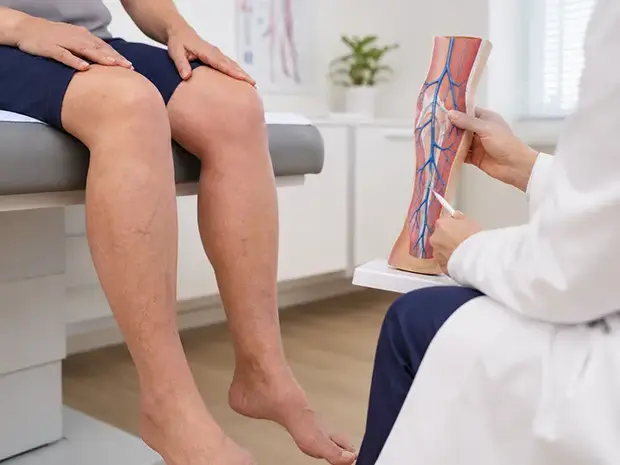
Varicose veins are not only the veins visible on the surface
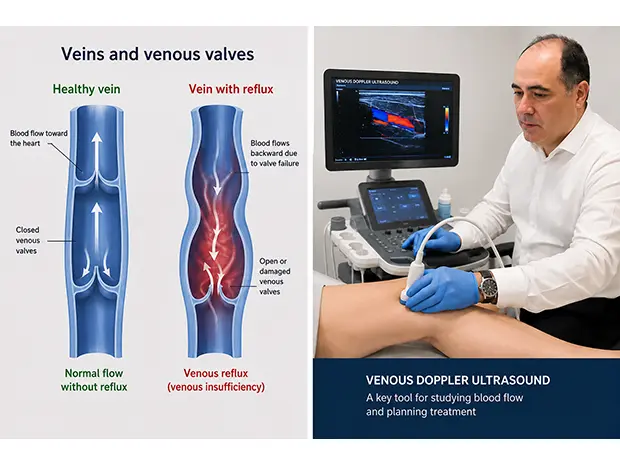
The veins in the legs carry blood back to the heart. To help this journey, they have small internal valves that help prevent blood from flowing backwards under the effect of gravity.
When these valves stop working properly, blood may flow in the wrong direction and increase pressure inside certain veins. This problem is known as venous insufficiency or venous reflux.
Visible varicose veins are one possible manifestation, but they do not always tell the whole story.
Two people may have veins that look similar and yet have completely different problems:
- isolated spider veins;
- reticular veins;
- tributary varicose veins;
- insufficiency of a saphenous vein;
- reflux arising from perforating veins;
- recurrence after previous treatment;
- symptoms that are not even venous in origin.
That is why the same treatment should not be offered automatically to every patient.
Before repairing a pipe, it is not enough to look at damp on the wall. You need to find out where the leak is.
Venous Doppler ultrasound shows what is really happening
Venous Doppler ultrasound is a specific ultrasound scan that allows us to study how blood flows through the veins.
It does not use radiation, causes no discomfort and provides essential information:
- which veins are working properly;
- where reflux is present;
- the origin of the varicose veins;
- whether superficial, deep or perforating veins are affected;
- the diameter of the vessels;
- which treatment may be most appropriate;
- which alternatives should be avoided in a specific case.
European clinical guidelines consider Doppler ultrasound the essential diagnostic test in chronic venous disease. They also recommend a complete study of the leg when there is clinical suspicion and using it to plan interventions.
US guidelines agree: they recommend duplex ultrasound as the diagnostic test of choice to assess venous reflux and state that the study should be interpreted by a qualified physician.
That is why you should be cautious if you are offered extensive treatment of one or both legs without first having an appropriate vascular assessment and a Doppler ultrasound when indicated.
What is sclerotherapy, really?
Sclerotherapy is a medical technique that has been known for many years. It consists of injecting a substance into certain veins to trigger a controlled reaction in their wall.
As a result, the treated vein may close, decrease in calibre and become less visible over time.
Put simply: the aim is not to “rejuvenate” the vein, but to selectively disable a diseased or less relevant vessel so that it stops causing the problem.
Sclerotherapy is not a fraudulent treatment. When properly indicated and correctly performed, it is very useful in certain situations, especially for:
- spider veins;
- reticular veins;
- some tributary varicose veins;
- residual varicose veins after other treatments;
- certain selected cases under ultrasound guidance.
European guidelines describe sclerotherapy as a minimally invasive option frequently used to treat varicose tributaries and residual veins. They also note that the concentration of the sclerosant should be adapted to the size of the vein and that certain punctures should be performed under ultrasound guidance to limit complications.
In previous articles, we have already explained that sclerotherapy essentially consists of producing a controlled chemical phlebitis to close the treated vein, and that its use in large veins continues to generate more controversy than its use in small vessels.
What does so-called T.R.A.P. regenerative phlebotherapy promise?
T.R.A.P. is usually presented as something different from conventional sclerotherapy.
Its main promise is not simply to close some visible veins. The commercial narrative often goes much further: it speaks of regenerating the venous wall, restoring normal vessel function, correcting venous hypertension and treating the problem at its source.
This distinction is fundamental.
If a clinic honestly offered a variant of sclerotherapy, clearly explaining its advantages, limitations, risks and alternatives, the patient could freely decide whether to accept it.
But if it is claimed that injections regenerate diseased veins and restore their function, that claim requires solid clinical evidence.
Has T.R.A.P. been shown to regenerate veins?
At present, there is not enough clinical evidence to state that T.R.A.P. regenerates varicose veins, repairs their valves or restores their normal function.
This does not necessarily mean that the injections have no effect. A substance injected into a vein can cause visible changes and make some varicose veins shrink or disappear.
But a vein that is no longer visible has not thereby been shown to have regenerated.
It may also have undergone a sclerosing reaction, which is precisely the known mechanism of sclerotherapy.
This distinction is essential:
The fact that a vein becomes smaller after an injection does not prove that it has recovered its normal function.
True venous regeneration should be demonstrated through rigorous clinical studies that include, among other aspects:
- Doppler ultrasound before and after treatment;
- previously defined objective criteria;
- comparison with conventional treatments;
- sufficient follow-up;
- detailed analysis of complications;
- transparent publication of results;
- reproduction of the findings by independent teams.
The main clinical guidelines consulted describe proven treatments such as endovenous ablation, sclerotherapy, phlebectomies and other techniques selected according to the type of venous disease. They do not provide a specific clinical recommendation that would allow T.R.A.P. to be presented as a proven regenerative therapy.
In previous articles, we had already warned about techniques that claimed to “cure” or regenerate veins through injections without publications of sufficient scientific rigour to justify that promise.

Changing the name does not turn sclerotherapy into venous regeneration
A technical variant may introduce real changes:
- a different substance;
- a different concentration;
- its own protocol;
- more sessions;
- a specific injection sequence;
- a broader approach to both legs.
But modifying the procedure does not automatically allow us to conclude that regeneration exists.
Nor can it be assumed that a lower concentration or a different formula is necessarily better or safer.
Any injected substance must be used with an appropriate indication, a known composition, cautious dosing and proper medical supervision. Sclerosants are not harmless products and may cause complications, especially if used without sufficient prior assessment or outside a reasonable indication.
Medical innovation is welcome. But a novel name is not a substitute for evidence.
And one further point: the mixtures of sclerosing substances that some T.R.A.P. practitioners have at times stated they use are not authorised by the Ministry of Health for use, precisely because data on efficacy and safety have not been provided.
A high price does not by itself prove deception
In private medicine, there can be significant price differences between centres. Cost depends on many factors:
- extent of the problem;
- number of sessions;
- complexity of treatment;
- professional experience;
- resources used;
- follow-up afterwards;
- the structure of the clinic.
Therefore, a high price does not by itself prove poor practice.
However, the situation changes if the extra cost is justified by an extraordinary therapeutic property that has not been demonstrated.
In our clinic, we are seeing patients who have been offered estimates of several thousand euros to treat both legs using techniques presented as regenerative.
The problem is not simply paying more.
The problem arises when the patient accepts that estimate because they believe they are paying for something completely different from sclerotherapy: a repair of their diseased veins and a recovery of their normal function.
If that regeneration is not scientifically proven, the decision may have been based on an incorrect expectation.
Pressure to pay immediately is a warning sign
Medical treatment should not be sold as a commercial opportunity that disappears within hours.
Be cautious if you hear phrases like these:
- “You have to book today”.
- “If you do not pay now, you will miss the opportunity”.
- “This price is only available if you sign immediately”.
- “You do not need to think about it any more”.
- “There is no need to seek another opinion”.
- “This technique works for every case”.
- “It has no significant risks”.
- “It regenerates the veins and cures the problem at its root”.
A limited schedule may be real. It may also be reasonable to request a deposit to reserve certain sessions.
But properly organising a private clinic is one thing; pressuring a patient to pay before they have understood the diagnosis, alternatives and limitations of the treatment is quite another.
Medicine requires information, reflection and free consent.
Who should assess your varicose veins?
In Spain, the reference medical specialty for the diagnosis and comprehensive treatment of varicose veins is Angiology and Vascular Surgery.
Other doctors may have acquired specific training in certain techniques. But when extensive treatment is offered for venous disease, knowing how to perform an injection is not enough.
The professional should be able to:
- correctly diagnose the origin of the problem;
- perform or interpret a venous Doppler ultrasound;
- differentiate a spider vein from relevant venous insufficiency;
- explain all reasonable alternatives;
- recognise when a technique is not indicated;
- prevent complications;
- act correctly if a problem appears.
In addition, a good specialist in this field should be able to master several different techniques (or ideally all those that are available and scientifically valid) in order to offer the patient the best option for their specific case. Otherwise, the professional may be recommending a particular technique because it is the only one they know how to perform, whether or not it is the most appropriate one for you.

Ten questions you should ask before booking treatment
Before arranging any treatment for varicose veins, ask:
- What is my exact diagnosis?
- Do I need a venous Doppler ultrasound?
- Which veins are not working properly?
- What substance will be injected?
- What is the real mechanism of the treatment?
- What studies show that it regenerates veins?
- What alternatives exist for my case?
- What risks and complications may occur?
- Which doctor will perform the procedure, and what is their specialty?
- Can I receive all the information and the estimate in writing before deciding?
A serious treatment should be explainable clearly, without rushing and without evasive answers.
Warning signs
Seek an independent second opinion if any of these situations occur:
- You are promised that any type of varicose vein can be cured with the same technique.
- Venous regeneration is presented as if it were a proven fact.
- They propose treating both legs without an adequate prior study.
- They do not explain which substance they will use.
- They do not provide a written diagnosis.
- They do not mention alternatives.
- They minimise any possible complication.
- They avoid answering what specialty the doctor has.
- They insist that you pay immediately.
- They try to prevent you from consulting another professional.
The more warning signs that coincide, the more cautious you should be.
So, is T.R.A.P. a scam?
It is not appropriate to state that all centres offering this treatment act in the same way. Nor can each case be legally classified without analysing the information provided to the patient, the advertising used, the informed consent and the treatment actually performed.
But from a medical point of view there is a clear problem:
Presenting an intervention as proven venous regeneration when it has not demonstrated that effect may mislead the patient.
T.R.A.P. may produce some clinical effect through the injection of substances into the veins. But there is not enough evidence to state that it regenerates varicose veins, repairs their valves or restores their normal function.
If, in addition, that promise is used to justify an extraordinary price and is accompanied by pressure to pay as soon as possible, it is reasonable to speak of a possible misleading commercial practice.
What to do if you have already booked the treatment
If you have already paid or have started the sessions:
- request a copy of your medical records;
- ask for the exact diagnosis;
- request the Doppler ultrasound report, if one has been performed;
- ask what substances have been used;
- keep the estimate, invoices and messages received;
- seek a second opinion from an independent specialist;
- seek urgent medical advice if you develop severe pain, sudden swelling of one leg, progressive redness, shortness of breath or any worrying symptom.
Conclusion
Varicose veins have effective and well-known treatments. The right choice depends on the origin of the problem, the size of the veins, the presence of reflux and the specific characteristics of each patient.
Before paying several thousand euros for supposed venous regeneration, ask for evidence, a diagnosis, written information, Doppler ultrasound before choosing treatment and enough time to decide.
Medical innovation is not demonstrated with attractive words, complex names or high estimates.
It is demonstrated with rigorous studies, safety, transparency and reproducible results.
Medical Notice
This article provides general educational information. It does not replace an individual medical assessment. If you have any questions about varicose veins, venous insufficiency or possible complications, consult a qualified professional.
FREQUENTLY ASKED QUESTIONS
Does T.R.A.P. really regenerate varicose veins?
There is not enough clinical evidence to state that it regenerates diseased veins, repairs their valves or restores their normal function. A visible reduction in some veins after an injection does not prove regeneration.
Is T.R.A.P. the same as sclerotherapy?
It is not marketed as the same thing. However, its clinically plausible effect may largely derive from a sclerosing action. It has not been shown to provide a distinct venous regeneration effect.
Is sclerotherapy a valid treatment?
Yes. Sclerotherapy is a known and useful medical technique when properly indicated, especially for spider veins, reticular veins and certain selected varicose veins.
Do I need a Doppler ultrasound before treating my varicose veins?
Before performing any treatment on a patient’s veins, whether they are large varicose veins or small spider veins, a venous Doppler ultrasound is necessary. This makes it possible not only to choose the best personalised treatment for that specific patient, but, even more importantly, to identify hidden problems that could contraindicate a particular treatment or make it less effective.
Who should assess my varicose veins?
It is advisable to see a professional with accredited training in venous disease, capable of correctly performing or interpreting Doppler ultrasound, explaining alternatives and managing possible complications. In Spain, the reference medical specialty is Angiology and Vascular Surgery.
Should I pay a deposit immediately?
You should have enough time to understand the information, review the estimate, consider alternatives, read the informed consent form (and ask all your questions) and seek a second opinion. Unjustified pressure to pay on the spot is a warning sign.
Should you be interested in getting to know this disease better, and its causes, consequences, how to treat them, and, even better, what can we do to prevent them, you can find it all well explained in the ebook VARICOSE VEINS: Truth & myths.