

In summer, many people notice more leg heaviness, swelling, itching, a feeling of pressure or cramps. In our clinic, we often see that these symptoms become more noticeable when temperatures rise, at the end of the day or after many hours standing.
It is common to think that everything is due to heat or “poor circulation”. And this may partly be true: high temperatures can make some venous symptoms more apparent. However, not all tired legs have the same cause, and it is not advisable to assume that every symptom is due to varicose veins.
Leg heaviness, swelling or cramps may have different causes. Sometimes there is venous insufficiency. In other cases, a sedentary lifestyle, excess weight, certain jobs, muscle, joint or lymphatic problems, or even some medicines may play a role. That is why, when symptoms recur, increase or interfere with everyday life, it is worth having a professional assessment.
In that context, venous Doppler ultrasound is a very useful tool. It not only allows us to see the veins, but also to study how the venous circulation is working and whether there is any problem that explains the symptoms.
Contents
Heat can make some venous symptoms more noticeable
High temperatures favour vasodilation, meaning an increase in the calibre of blood vessels. In people with venous disease or a tendency to venous insufficiency, this can make symptoms more noticeable.

When the veins in the legs do not return blood to the heart efficiently, a feeling of congestion, pressure or tiredness may appear. This is usually more noticeable in situations where blood has to overcome gravity for many hours: standing still, sitting for a long time, working in hot environments or being exposed to the sun for prolonged periods.
The most common venous symptoms may include heaviness, tiredness, swelling of the ankles or calves, itching, tingling, burning or a feeling of tightness. Some varicose veins or superficial veins may also become more visible.
Even so, these symptoms do not always mean that there is a significant venous problem. Some people have visible varicose veins and few symptoms, while others have clear symptoms without large external varicose veins. That is why it is important not to rely only on what can be seen externally.
Why it is more noticeable at the end of the day
During the night, while lying down, the legs remain horizontal and venous return is usually easier. That is why many people wake up with their legs feeling more rested or less swollen.
The opposite happens throughout the day. When standing or sitting, the veins in the legs have to move blood up towards the heart against gravity. Mechanisms such as contraction of the calf muscles when walking and the venous valves, which guide flow in the right direction, help with this task.
When these mechanisms do not work well, the feeling of heaviness may increase as the hours pass. This explains why many people feel better in the morning and notice their legs are much worse in the afternoon or at night.
Cramps: a symptom that needs context
Cramps may appear in people with venous disease, but they are not specific to a venous problem. They may also be related to muscle overload, lack of movement, dehydration, certain medicines or other causes.
For that reason, an isolated cramp is not enough to conclude that there are varicose veins or venous insufficiency. What matters is assessing the whole picture: when they appear, how often, and whether they are accompanied by swelling, heaviness, visible veins, localised pain or skin changes.
What venous Doppler ultrasound provides
The article on venous Doppler ultrasound explains this examination in detail. In simple terms, venous Doppler ultrasound is a specific ultrasound scan that allows the veins in the legs to be studied from both an anatomical and a functional point of view.
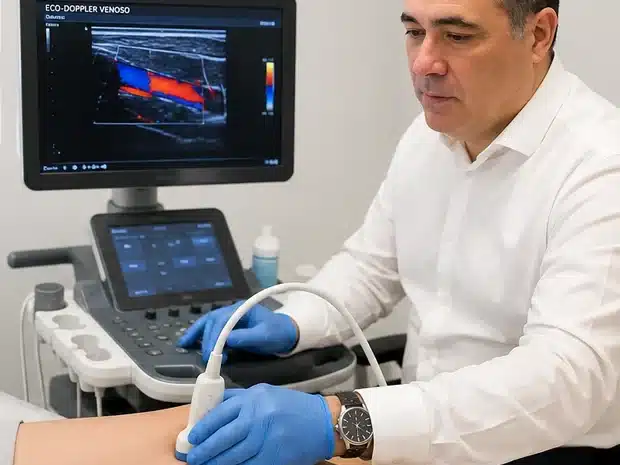
This means that it not only shows what the veins look like, but also how blood circulates inside them. In venous disease, this information is key, because the problem is not always that a vein is visible or dilated. Very often, what matters is knowing whether there is venous reflux, meaning blood flows backwards due to valve failure.
Doppler ultrasound may help study whether venous insufficiency is present, which veins are affected, whether varicose veins depend on a main vein, whether the superficial or deep venous system is involved, and whether there are findings compatible with venous thrombosis or sequelae of a previous thrombosis.
It usually requires no special preparation and there is no need to attend fasting. It should be performed with the patient standing or in a position that allows the behaviour of the veins with gravity to be assessed more clearly. This is important because some venous problems appear precisely when the leg is in a dependent position.
It is not just a test “to confirm varicose veins”
A common idea is to think that Doppler ultrasound is only useful when varicose veins are very obvious. In reality, its usefulness goes much further.
There may be visible veins without a relevant venous problem from a functional point of view. And there may also be venous symptoms without very prominent varicose veins. That is why clinical examination and Doppler ultrasound complement each other.
The examination allows symptoms, the appearance of the skin, the distribution of visible veins and the presence of swelling to be assessed. Doppler ultrasound helps confirm, rule out or qualify what is suspected.
In practice, this test makes it possible to move from a general impression —“my legs feel heavy”— to a more specific assessment: which veins work well, which do not, and whether there are findings that justify treatment or follow-up.
A useful tool before deciding on treatment
Before considering any treatment for varicose veins, diagnosis is essential. Not all varicose veins are treated in the same way. The indication may vary depending on venous anatomy, the type of reflux, vein calibre, symptoms, medical history and each patient’s priorities.
Options such as radiofrequency, VenaSeal®, sclerotherapy or other procedures should be considered with proper planning. Treating only what is seen on the skin, without understanding where the problem comes from, may lead to incomplete decisions.
Doppler ultrasound helps build that venous map. It makes it possible to identify whether a saphenous vein is affected, whether the problem depends on superficial branches, whether there is deep vein involvement, or whether a history of thrombosis may influence the strategy.
This information does not necessarily mean treatment is required. Sometimes it points towards conservative measures. In other cases, it helps explain what options are available and which may make more sense in each case.
When it is advisable to seek advice
It is reasonable to request a vascular assessment when persistent or recurring symptoms appear, such as heaviness, tiredness, swelling, itching, cramps, burning or a feeling of pressure in the legs, especially if they worsen with heat, at the end of the day or after spending many hours standing.
It is also advisable to seek advice when there are visible varicose veins, spider veins associated with symptoms, a personal history of thrombosis, previous varicose vein treatments, skin changes on the leg or swelling that is not well explained.
There is no need to wait until the problem is very obvious. The aim of seeking advice is not to become alarmed or assume that treatment is needed, but to understand the cause of the symptoms.
Signs that are worth assessing
Common reasons for consultation include daily or almost daily heaviness, ankle swelling in the afternoon, varicose veins that increase in size or cause discomfort, persistent itching, changes in skin colour or repeated cramps with no clear cause.
Inflammation over a superficial vein, localised pain or the appearance of new symptoms in a person with a history of venous thrombosis also deserve attention.
In these cases, assessment helps decide whether venous Doppler ultrasound is indicated and what information it may provide.
When care should be more urgent
Some situations should not be assessed only with general information. If significant swelling of one leg appears suddenly, with intense pain, marked redness, increased local temperature or shortness of breath, it is important to seek medical care promptly.
These symptoms do not always mean that there is a thrombosis or another serious problem, but they do justify priority assessment to rule out situations that require specific management.
It is also advisable to be especially cautious if there is a history of thrombosis, recent surgery, prolonged immobilisation, recent long journeys, pregnancy or the postpartum period, hormone treatment or cancer.
Useful measures while waiting for assessment
While assessment is being arranged, many people may improve partially with simple habits. These measures do not replace diagnosis, but they may help reduce the feeling of overload, especially during hot months.

Walking regularly is usually useful. The calf muscles act as a pump that helps push blood upwards. That is why standing still is usually worse than walking.
Active breaks during work, moving the ankles, avoiding long periods without movement, raising the legs for a few minutes at the end of the day and reducing prolonged exposure to intense heat may also help. Cooling the legs with cool water may provide temporary relief for some people.

Maintaining an active lifestyle, managing weight when appropriate, avoiding excessively tight clothing and wearing comfortable footwear are reasonable measures. However, self-medication or starting specific treatments without assessment is not advisable.
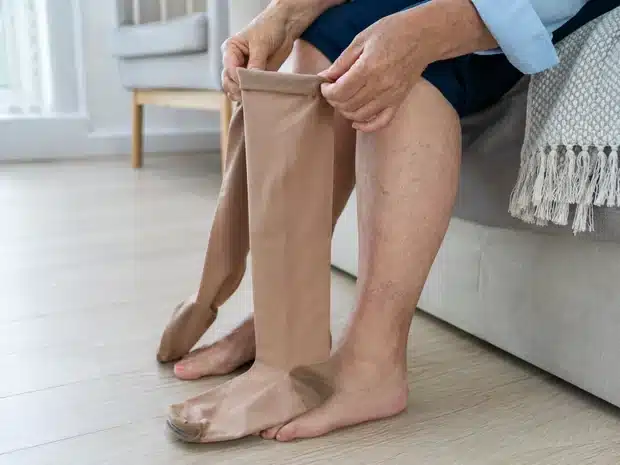
Compression stockings can be very useful in some cases, but they are not all the same and are not suitable for everyone. Their type, size, length and compression level should be indicated according to the clinical situation. The same applies to venoactive medicines, diuretics or other products: they should be used with medical judgement.
Not all tired legs mean the same thing
Heaviness or swelling may have different causes. For this reason, before assuming that it is due to varicose veins or venous insufficiency, it is advisable to examine, ask about the symptoms and complete the study when indicated.
In clinic, Doppler ultrasound helps organise that information. It makes it possible to distinguish between symptoms compatible with venous insufficiency, superficial varicose veins with or without relevant reflux, deep venous system problems, sequelae of thrombosis, or situations in which the venous study does not explain the symptoms.
A normal Doppler ultrasound is not a useless test. On the contrary: it helps rule out a significant venous cause and allows the search to be directed towards other reasons if symptoms persist.
The key is to individualise. There is no single explanation for all tired legs and no single solution for all varicose veins. Each case should be assessed according to symptoms, examination, history and study findings.
Request an assessment
If you notice heaviness, swelling or cramps that recur with heat, a vascular assessment may help you better understand the cause and decide the next step.
At Clínica Vascular Dr. Jorge Molina, in Valencia, we study each case individually to assess whether the symptoms may be related to varicose veins, venous insufficiency or other circulatory problems, and whether venous Doppler ultrasound may provide useful information to guide the diagnosis.
Notice: this information is general and does not replace a medical consultation. If symptoms are sudden, intense or concerning, seek medical care as a priority.
FREQUENTLY ASKED QUESTIONS
Do cramps mean I have varicose veins?
Not necessarily. They may appear in some cases of venous disease, but they may also have other causes. If they are frequent, intense or accompanied by swelling, heaviness or visible varicose veins, it is advisable to have them assessed.
Does Doppler ultrasound hurt?
No. It is an ultrasound scan. It does not require needles, contrast or special preparation. It is a very well-tolerated test.
Do I need visible varicose veins to seek advice?
No. Venous symptoms may occur without very obvious varicose veins. The indication for seeking advice depends on the overall symptoms, history and examination.
Does heat cause varicose veins?
Heat is not usually the only cause of varicose veins, but it can make symptoms more noticeable. In people with venous disease, high temperatures may increase the feeling of heaviness, swelling or tiredness.
Can compression stockings help me?
They may help in many cases, but they should be indicated correctly. Not all stockings are the same, and an inappropriate choice may be uncomfortable or not very effective.
Is Doppler ultrasound useful for planning varicose vein treatment?
Yes. When varicose vein treatment is being considered, venous Doppler ultrasound is essential to know which veins are affected and how the venous system is working.
Should you be interested in getting to know this disease better, and its causes, consequences, how to treat them, and, even better, what can we do to prevent them, you can find it all well explained in the ebook VARICOSE VEINS: Truth & myths.