
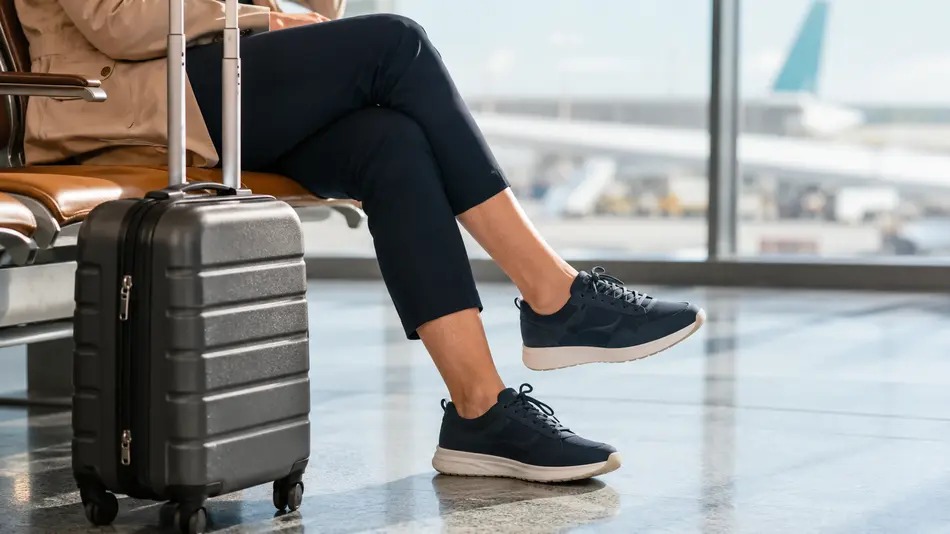
Travel is one of the best parts of a holiday, but it can also put the circulation in your legs to the test. This does not only apply to transoceanic flights: a long journey by plane, bus, train or car can mean spending several hours sitting, with little space to move your legs and, sometimes, with heat, dehydration or clothing that is too tight.
In our clinic, we often see patients who, after a trip, notice that their legs are more swollen, heavier or more uncomfortable than usual. In most cases, these are mild and temporary symptoms. However, in some people, prolonged immobility may contribute to vascular problems that are worth knowing about: swelling, worsening of varicose veins, superficial phlebitis, varicophlebitis when varicose veins are already present, worsening of lymphoedema or, in less common but more important cases, deep vein thrombosis.
The aim of this article is not to alarm you before travelling, but to help you understand what may happen, which simple measures may reduce the risk, and when it is advisable to consult a vascular surgeon before or after a journey.
Contents
- Why long journeys can affect circulation
- Vascular problems that may appear during or after a trip
- General preventive measures during the journey
- Should I take aspirin or anticoagulants before travelling?
- When to seek advice before travelling
- When to seek advice after travelling
- Travelling with peace of mind also means preventing problems
- FREQUENTLY ASKED QUESTIONS
Why long journeys can affect circulation
Blood from the legs has to return to the heart against gravity. To do this, the veins have internal valves and rely heavily on the calf muscles. Every time we walk or move our ankles, the leg muscles act like a pump that helps venous return.
When we spend many hours sitting, this muscle pump works much less. If we also keep our knees bent, wear tight clothing or drink very little fluid, venous circulation may slow down. This slower flow favours fluid accumulation in the legs and, in people who are predisposed, may contribute to clot formation.
For this reason, the problem is not only related to flying. It can also occur during long journeys by bus, car or train, especially when many hours of immobility are combined with other risk factors.

Vascular problems that may appear during or after a trip
Leg swelling
Swelling is caused by fluid building up in the tissues. During a long journey, it may appear in both ankles or legs, especially towards the end of the trip. It is usually related to immobility, heat, sustained pressure while sitting and difficulty with venous return.
In people without significant vascular disease, this swelling may improve by walking, elevating the legs and returning to usual activity. Even so, it should not be dismissed if it is very marked, if it affects only one leg or if it is accompanied by pain, warmth or changes in skin colour.
Worsening of venous symptoms and varicose veins
If you already have varicose veins or venous insufficiency, long journeys may make you notice more heaviness, tiredness, pressure, cramps, itching or swelling. This does not necessarily mean that the varicose veins have permanently worsened, but it does mean that the venous system is under more strain in a situation of immobility.

Varicose veins are dilated superficial veins that do not perform their return function properly. Blood flows through them with more difficulty and may stagnate. That is why, when a person with varicose veins spends many hours sitting, the journey may trigger symptoms or complications.
If you have visible varicose veins, frequent symptoms or a history of phlebitis or thrombosis, an assessment before a long trip may be especially useful. In these cases, a venous Doppler ultrasound makes it possible to study how the veins are working, confirm or rule out thrombosis or old sequelae, and plan the most appropriate treatment or preventive measures.
Superficial phlebitis and varicophlebitis
Superficial phlebitis consists of a clot forming in a superficial vein, together with inflammation of the vein wall. When it occurs in a pre-existing varicose vein, it is often called varicophlebitis.
It may appear as a painful, warm, red or hardened area following the path of a superficial vein. Sometimes it feels like a hard cord under the skin. Although it is different from deep vein thrombosis, it should be medically assessed, because the extent, location and risk factors of each patient influence treatment.
In general, if superficial phlebitis is suspected, simply waiting or self-medicating is not a good idea. It is advisable to seek medical advice as soon as possible, especially if the pain progresses, if the inflamed area is near the groin or behind the knee, if there is a history of thrombosis or if general symptoms appear.
Deep vein thrombosis
Deep vein thrombosis, or DVT, occurs when a clot forms in a deep vein, usually in the leg. It is more serious than superficial phlebitis because, in some cases, the clot can travel to the lung and cause a pulmonary embolism, which is potentially dangerous.
Long journeys may increase the risk in predisposed people, especially when there are factors such as a personal or family history of thrombosis, recent surgery or injury, cancer, pregnancy or the postpartum period, obesity, smoking, advanced age, hormonal contraceptives, thrombophilias, heart or kidney failure, or previous venous disease.
DVT may cause swelling of one leg, pain, heaviness, increased local temperature or a change in colour. It does not always cause all of these symptoms, and sometimes it may go unnoticed. For this reason, if clearly asymmetrical swelling, new pain in one leg, or a feeling of warmth and redness appears after a trip, urgent medical assessment is recommended.
If sudden shortness of breath, chest pain, feeling faint, rapid breathing, a fast pulse or coughing up blood also appears, you should go to the emergency department without delay.
Worsening of lymphoedema
Lymphoedema is swelling caused by difficulty in the lymphatic system draining fluid from the tissues. It may affect the legs or arms, and in some patients it appears after surgery, cancer treatments, radiotherapy or other causes.
During a long journey, lymphoedema may worsen due to immobility, heat, sustained posture and the inability to carry out usual care measures. In these patients, planning is important: compression garments indicated by the specialist, skin care, frequent movement and avoiding knocks or friction may help reduce problems.
If you have known lymphoedema and are going to take a long trip, especially by plane or to a hot destination, it may be advisable to consult beforehand to adjust preventive measures.
General preventive measures during the journey
Preventive measures do not completely eliminate the risk, but they may help reduce it, especially on long journeys.
Move frequently
The most important recommendation is to avoid staying still for many hours. If you travel by plane, train or bus, try to get up and walk along the aisle whenever possible. If you travel by car, plan stops to walk for a few minutes.
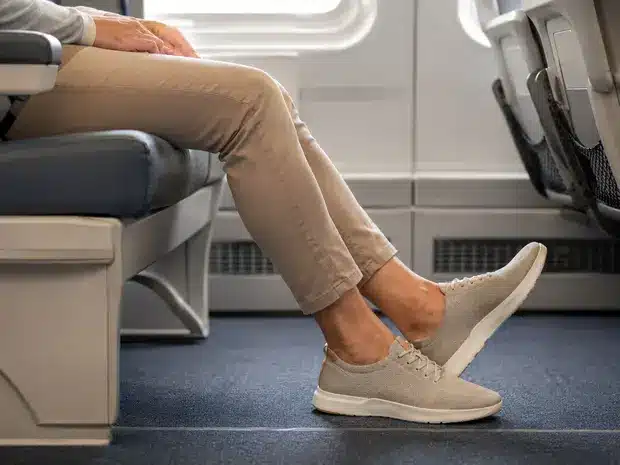
When you cannot get up, do ankle exercises: flex and extend your feet as if pressing and releasing a pedal. You can also make circular ankle movements and gentle calf contractions. The important thing is to activate the leg muscles repeatedly.
Wear comfortable clothing
During a long journey, it is advisable to avoid clothing that is too tight around the waist, groin, thighs or knees. Comfortable clothing makes movement easier and avoids unnecessary compression.
Stay well hydrated
Dehydration may make the blood more concentrated. For this reason, it is advisable to drink water during the journey. Alcohol and too much coffee may contribute to dehydration in some people, so it is better to keep them moderate, especially on long trips.
Avoid excessive heat
Heat promotes vasodilation and may increase the feeling of heaviness, swelling and venous discomfort. In summer or in hot destinations, try to keep your legs cool, walk during the cooler hours of the day and avoid prolonged sun exposure if you notice your venous symptoms worsening.
Consider compression stockings if they are indicated
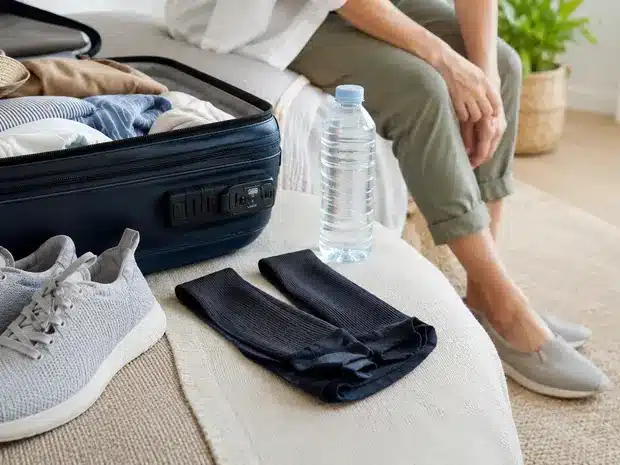
Compression stockings or socks may be useful for many people with venous insufficiency, varicose veins, swelling or a history of thrombosis, but not all stockings are suitable for every case. The size, length and level of compression should be adapted to each patient.
If you have arterial disease, neuropathy, wounds, significant pain or doubts about what compression to use, it is not advisable to buy just any stocking without an assessment. In these cases, it is better to consult beforehand.

Should I take aspirin or anticoagulants before travelling?
You should not self-medicate to prevent clots during a trip. The use of acetylsalicylic acid for this purpose is controversial and should not be assumed to be a general preventive measure.
In patients at moderate or high risk, such as people with a history of deep vein thrombosis or pulmonary embolism, cancer, recent surgery, recent injury, pregnancy, the postpartum period, thrombophilia or other relevant factors, the doctor may consider specific measures, including pharmacological prophylaxis in some cases. This decision must be individualised and always made under medical indication.
When to seek advice before travelling
It may be advisable to request an assessment with a vascular surgeon before travelling if you have:
- A personal history of deep vein thrombosis, pulmonary embolism or recurrent phlebitis.
- Significant varicose veins, pain, heaviness or frequent leg swelling.
- Known lymphoedema or chronic swelling of a limb.
- Recent surgery, recent trauma or previous immobilisation.
- Active cancer treatment or a recent history of cancer.
- Pregnancy, the postpartum period or hormonal treatment with other risk factors.
- Swelling of one leg that has not yet been diagnosed.
- Doubts about whether you should use compression stockings or what type of compression is appropriate.
A prior assessment makes it possible to estimate risk, review your medical history, examine the legs and, if appropriate, perform a venous Doppler ultrasound to make decisions more safely.
When to seek advice after travelling
After a long trip, seek medical advice if new and marked swelling appears, especially if it affects one leg more than the other. Also do so if you notice pain in the calf or thigh, local warmth, redness, a change in colour, a hard and painful superficial vein or clear worsening of your varicose veins.
Go to the emergency department if symptoms compatible with pulmonary embolism appear, such as sudden shortness of breath, chest pain, fainting, rapid breathing, a fast pulse or coughing up blood.
Not all these symptoms mean that thrombosis is present, but they do justify medical assessment to rule it out.
Travelling with peace of mind also means preventing problems
Most people can travel without major problems, but it is worth keeping one simple idea in mind: legs need movement. On long journeys, moving, staying hydrated, avoiding tight clothing and considering compression when it is indicated may make a difference.
If you have varicose veins, lymphoedema, frequent swelling or a history of thrombosis, do not wait for a problem to appear during your holidays. A vascular assessment before travelling may help you know which measures are appropriate for your case.
The information in this article is general and does not replace a medical consultation. If you have symptoms compatible with deep vein thrombosis or pulmonary embolism, seek urgent medical advice.
FREQUENTLY ASKED QUESTIONS
Is it normal for ankles to swell after a long trip?
It can happen, especially after many hours sitting, in heat or with little movement. If the swelling is mild, affects both sides and improves when you walk or elevate your legs, it is usually less concerning. If it is intense, appears only in one leg or is accompanied by pain, warmth or redness, you should consult your vascular surgeon.
Do varicose veins increase the risk during a trip?
Varicose veins may favour discomfort, heaviness, swelling and, in some cases, superficial phlebitis. Individual risk depends on each person’s venous situation and other associated factors. If you have symptomatic varicose veins or a history of phlebitis, it is advisable to seek advice before long journeys.
Are compression stockings recommended for all travellers?
It is a common recommendation in international guidelines for the prevention of deep vein thrombosis that all people taking a flight lasting more than 4 hours should use appropriate compression stockings in order to prevent the possibility of venous thrombosis during the flight. In people with a history of deep vein thrombosis, superficial phlebitis, varicose veins, lymphoedema or usual swelling from another cause (cardiac, renal, etc.), this is even more important.
On top of this recommendation, on any type of long journey (not only by plane), compression stockings will help prevent swelling or heaviness in the legs during or after the trip, so they are generally recommended for everyone unless there is a clear contraindication to their use.
But there is a key point here: they must be chosen properly. An inappropriate stocking may be uncomfortable or not very effective. Ideally, the type of compression should be adapted to the specific case, and your vascular surgeon should help you with this.
Does walking during the trip really help?
Yes. Contraction of the calf muscles supports venous return. That is why walking for a few minutes and doing ankle exercises during the journey are simple and useful measures.
Can I travel if I have had a thrombosis?
It depends on when it happened, the treatment, the progress and the type of trip. There is no single answer. If you have had a recent thrombosis or are on anticoagulant treatment, consult your doctor before arranging a long journey.
What should I do if I have lymphoedema and I am going to fly?
Plan the trip in advance. Use the compression garments indicated if they have been prescribed, take care of your skin, avoid knocks or friction, move during the journey and seek advice if the volume of the limb clearly increases or inflammatory signs appear.

Should you be interested in getting to know this disease better, and its causes, consequences, how to treat them, and, even better, what can we do to prevent them, you can find it all well explained in the ebook VARICOSE VEINS: Truth & myths.