
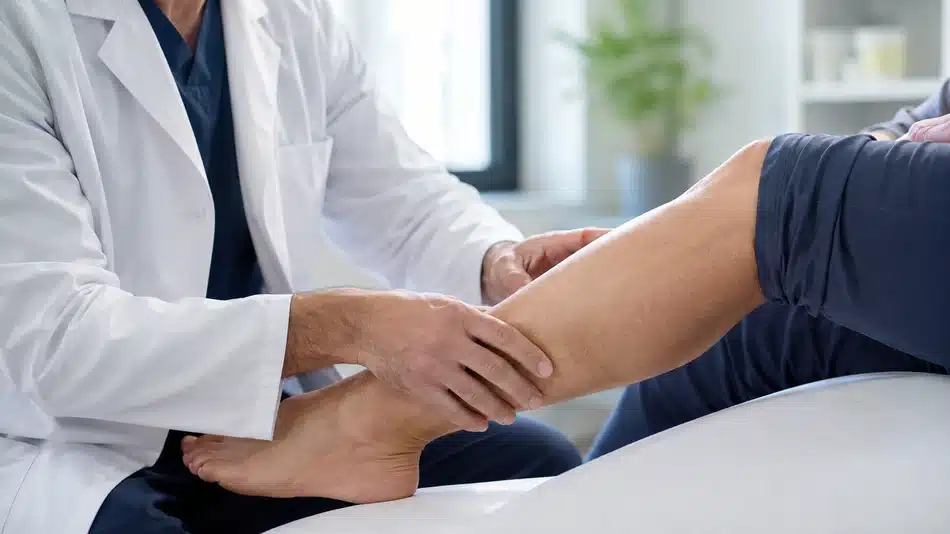
Deep vein thrombosis, also known as DVT, is a vascular condition that is worth understanding well because it may begin with relatively subtle symptoms and yet have important consequences if it is not diagnosed and treated in time.
In our clinic, we often see patients who have heard about “thrombosis”, “phlebitis” or “blood clots”, but are not always clear whether the problem is superficial, deep, mild or potentially serious. This distinction is essential.
Deep vein thrombosis occurs when a blood clot, called a thrombus, forms inside a deep vein. Although it can appear in different locations, it is especially common in the legs. These deep veins are the main pathways that return blood from the limbs to the heart. For this reason, when they become partially or completely blocked, venous circulation may be compromised.
DVT should not be confused with superficial vein thrombosis. In superficial thrombosis, the clot affects veins closer to the skin. In deep vein thrombosis, the problem appears in more important veins, located between the muscle planes, and with greater relevance for venous return from the limb.
Contents
- What exactly happens in deep vein thrombosis
- Causes and factors that may favour DVT
- Why deep vein thrombosis can be dangerous
- Symptoms of deep vein thrombosis
- The importance of early diagnosis
- Post-phlebitic syndrome: the chronic consequence of thrombosis
- General preventive measures
- Is rest necessary if DVT is diagnosed?
- When to consult a vascular surgeon
- Conclusion
- FREQUENTLY ASKED QUESTIONS
What exactly happens in deep vein thrombosis
Put simply, veins are the blood vessels responsible for returning blood from the legs to the heart. In the lower limbs, this function depends largely on the deep venous system, which carries most of the venous flow.
When a thrombus forms inside one of these veins, the blood encounters an obstacle to circulation. That obstruction may be partial or complete. If it is significant, blood builds up below the affected area and swelling, heaviness or pain in the leg may appear.
In addition, during the first few days, the thrombus may have a softer consistency. In this early phase, one of the main medical concerns is that a fragment of the clot may break off, travel through the circulation and reach the lung. This is known as pulmonary embolism.
For this reason, deep vein thrombosis is considered a condition that requires urgent medical assessment. The aim is not to cause alarm, but to understand that, with certain symptoms, waiting “to see if it goes away” may not be a good decision.
Causes and factors that may favour DVT
The formation of a thrombus usually depends on several factors. In medicine, we classically refer to situations that favour blood clotting, slow venous flow or damage the vein wall.
Factors that may increase the risk of deep vein thrombosis include:
- Prolonged immobility, for example after surgery, a hospital admission, a debilitating illness or long periods in bed.
- Long journeys, especially when someone remains seated for many hours with little leg movement.
- Some congenital or acquired clotting disorders, known as thrombophilias.
- Certain diseases, such as some oncological or inflammatory conditions.
- Recent surgery or trauma.
- Pregnancy and the postpartum period, in certain circumstances.
- Some hormonal treatments, depending on each patient’s risk profile.
- A personal or family history of thrombosis.
- Being overweight, a sedentary lifestyle or reduced mobility.
A single cause is not always identified. Sometimes DVT appears as the result of several factors combined, and even after a thorough study it may not be possible to identify a specific cause. That is why it is important for the vascular surgeon to assess the full context: symptoms, medical history, medication, recent journeys, surgery, associated diseases and family factors.
Why deep vein thrombosis can be dangerous
DVT can be dangerous for two main reasons: its immediate complications and its long-term consequences.
The most feared immediate complication is pulmonary embolism. If part of the thrombus breaks off, it can travel with the blood to the heart and from there reach the pulmonary arteries. Depending on the size of the clot and the pulmonary vessel it blocks, the consequences can vary greatly.
In some cases, a small embolism may go unnoticed or cause mild symptoms. In others, it may cause chest pain, shortness of breath, cough, dizziness or a more serious clinical picture. Pulmonary embolism is a medical condition that requires urgent care.
The second reason why DVT matters is its possible chronic impact. Although the thrombus stabilises or gradually dissolves over time, the vein often remains damaged. The internal valves of the vein, which help blood move up towards the heart and prevent it from flowing backwards, may be impaired. In other cases, the vein may remain partially blocked.
When this happens, venous circulation in the leg may become less effective, with slower and more problematic return flow. Over time, what is known as post-phlebitic syndrome or post-thrombotic syndrome may appear.
Symptoms of deep vein thrombosis
The symptoms of DVT can vary widely. Some patients have clear symptoms, while in others the clinical picture is more subtle. This means the diagnosis is not always obvious without additional tests.
The most common symptoms are:
- Swelling of one leg (oedema), especially if it is clearly asymmetrical compared with the other, often appearing suddenly or within a few hours.
- Pain or discomfort in the calf, thigh or affected area.
- A feeling of tightness, heaviness or pressure in the limb.
- Increased local temperature.
- Changes in skin colour.
- Greater tenderness or pain when walking or standing.

Asymmetry is an important clue. It is not the same to notice both legs feeling tired at the end of the day as it is to see one leg becoming noticeably more swollen than the other, especially if this has appeared recently. If you would like to learn more about this symptom, you can also read the article on lower limb swelling and swollen legs.
Respiratory symptoms also deserve attention. If shortness of breath, chest pain, cough, dizziness or a feeling of fainting appears together with leg pain or swelling, you should seek urgent medical care.
The importance of early diagnosis
Early diagnosis of deep vein thrombosis is important for several reasons.
The first is to start the appropriate treatment as soon as possible. In most cases, the main treatment is anticoagulant medication. Its aim is to prevent the thrombus from progressing and to reduce the risk of complications. The choice of treatment, dose and duration depends on each patient and must always be indicated by a doctor.
The second reason is to assess the extent of the thrombosis. Not all DVTs are the same. It may be a more distal thrombosis, limited to segments of the leg, or a more proximal thrombosis, involving larger-calibre veins. This information changes the risk assessment and the therapeutic approach.
The third reason is to detect possible complications or associated factors. In certain cases, it may be necessary to investigate underlying diseases, clotting disorders or anatomical situations that favour thrombosis.
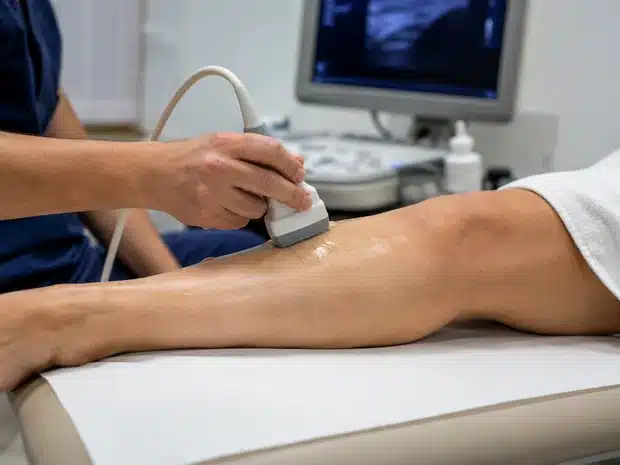
The key test for assessing suspected DVT in the legs is usually venous Doppler ultrasound. This is a non-invasive examination that allows the doctor to assess venous flow, check whether a thrombus is present and locate which segments are affected. In more extensive or complex cases, especially if involvement of the iliac veins, vena cava or pulmonary embolism is suspected, other hospital tests such as CT angiography or specific studies may be needed.
Post-phlebitic syndrome: the chronic consequence of thrombosis
Post-phlebitic syndrome, also called post-thrombotic syndrome, is one of the most important long-term consequences of deep vein thrombosis.
After a DVT, several things can happen. In some patients, the body manages to recanalise the vein and part of the flow starts circulating again. In others, the vein may remain partially or completely obstructed. But even when the vein is recanalised, its valves often remain damaged.
The problem is that these valves are essential for blood to move properly from the leg towards the heart. If they are destroyed or do not work well, blood tends to circulate more slowly and venous return becomes poorer. This increases venous pressure in the limb and favours symptoms of venous insufficiency.
Post-phlebitic syndrome may present with:
- Chronic swelling of the leg.
- Heaviness or pain when standing.
- A feeling of tightness.
- Worsening in hot weather.
- Development of secondary varicose veins.
- Skin changes, especially around the ankle.
- Dark pigmentation.
- Dryness, itching or eczema.
- In advanced cases, venous ulcers may appear.
Not everyone who has had a DVT develops significant post-phlebitic syndrome, but it is a possibility that should be taken into account. Prevention, follow-up and control measures are essential to reduce the long-term impact.
General preventive measures
Prevention of deep vein thrombosis depends on each person’s risk profile. Not all measures are necessary for everyone, and in high-risk patients pharmacological prevention prescribed by a doctor may be needed. Even so, there are useful general measures to support venous return and reduce situations in which blood stagnates.
Maintaining mobility
Walking and moving the legs help activate the calf muscles, which act as a natural pump to push blood upwards. During long journeys or long periods sitting, it is advisable to get up periodically, walk for a few minutes and perform ankle movements.

Avoiding prolonged immobility
Immobility is one of the classic factors that favours thrombosis. After surgery, illness or a period of rest, mobilisation should always follow medical instructions, but when it is allowed, it is usually beneficial.
Controlling weight
Being overweight can make venous return more difficult and worsen symptoms of venous insufficiency. Maintaining a healthy weight is part of general vascular prevention.
Staying properly hydrated
During long journeys, hot weather or situations with greater fluid loss, maintaining adequate hydration may help general wellbeing. It does not replace other preventive measures, but it is part of healthy habits.
Using compression stockings when indicated
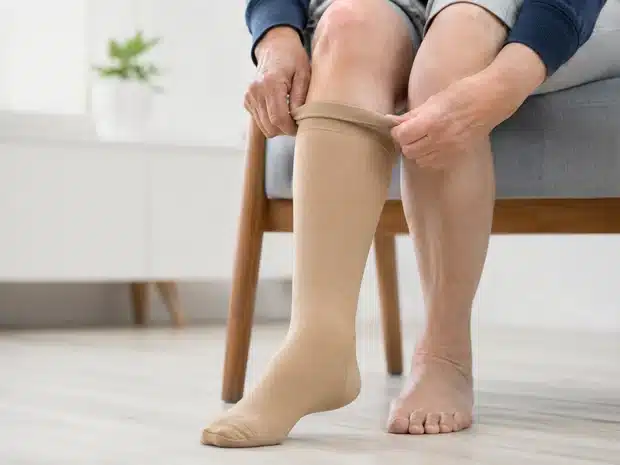
Compression stockings can be useful in certain patients, both for venous symptoms and during follow-up after a thrombosis, or even as a preventive measure in risk situations. However, not all stockings are the same. There are different compression levels, sizes and fabric types. Ideally, they should be prescribed or recommended by a professional who assesses each case.
Consulting before long journeys if there is risk
People with a history of thrombosis, recent surgery, cancer, pregnancy, hormonal treatments or clotting disorders should seek advice before long journeys. In some cases, general measures may not be enough and an individualised strategy is required.
Is rest necessary if DVT is diagnosed?
For a long time, thrombosis was associated with absolute bed rest. Today, in many cases, once DVT has been diagnosed and appropriate treatment has started, patients are advised to avoid absolute rest and to favour progressive mobilisation, always according to medical instructions.

This mobilisation is often combined with rest with the legs elevated and, in many patients, elastic compression. The aim is to reduce swelling, relieve pain and support venous return.
There are exceptions. In very extensive thrombosis, serious clinical pictures, the presence of pulmonary embolism or patients with a high bleeding risk, hospital admission or initial rest may be necessary. This is why it is so important not to generalise: each DVT must be assessed individually.
When to consult a vascular surgeon
It is advisable to consult a vascular surgeon if sudden swelling of one leg appears, especially if it is accompanied by pain, tightness, local warmth or a change in colour. It is also advisable if there is a previous history of thrombosis and similar symptoms reappear.
Vascular assessment is especially recommended in these cases:
- Suspected deep vein thrombosis.
- Swelling of one leg that is clearly greater than the other.
- Recent onset of calf or thigh pain without a clear explanation.
- A history of DVT or pulmonary embolism.
- New varicose veins or worsening after a thrombosis.
- Persistent swelling after a DVT.
- Changes in the skin around the ankle, pigmentation, eczema or wounds.
- Need to assess suitable compression stockings.
- Questions about prevention before journeys, surgery or periods of immobilisation.
If the symptoms are accompanied by shortness of breath, chest pain, coughing up blood, severe dizziness or loss of consciousness, you should not wait for a scheduled appointment: you must go to the Emergency Department.
Conclusion
Deep vein thrombosis is a vascular condition that deserves attention. Not because we should live in fear, but because recognising its symptoms and seeking advice in time can make an important difference.
A leg that swells suddenly, especially if it swells more than the other, with pain, tightness or local warmth, should be assessed. Diagnosis with venous Doppler ultrasound can confirm or rule out the suspicion in many cases and guide treatment.
In addition to the acute phase, it is important not to forget long-term follow-up. Post-phlebitic syndrome can affect quality of life and cause chronic symptoms if it is not properly controlled.
If in doubt, discuss your case with a vascular surgery specialist. General information may help you understand the problem, but it does not replace personalised medical assessment.
Medical notice: This content is for general informational purposes only. It does not replace a medical consultation, cannot diagnose individual cases and should not be used to start, modify or stop treatments. If you suspect deep vein thrombosis or have associated respiratory symptoms, seek medical care.
FREQUENTLY ASKED QUESTIONS
Does DVT always cause symptoms?
Not always. Some thromboses may cause subtle symptoms or even go unnoticed. That is why, when there is clinical suspicion or important risk factors, an imaging test may be necessary.
Is DVT the same as phlebitis?
Not exactly. The term “phlebitis” has been used very broadly for years, but it can cause confusion. It is more precise to distinguish between superficial vein thrombosis and deep vein thrombosis, because their severity, treatment and consequences can be very different.
Can thrombosis be cured?
In many cases, treatment can control the condition, prevent the thrombus from progressing and help the body gradually resolve it. However, the vein may be left with sequelae, especially if its valves are damaged. That is why follow-up is important.
Which is more dangerous: the clot in the leg or if it reaches the lung?
DVT is already important in itself, but the most feared immediate complication is that part of the thrombus breaks off and causes a pulmonary embolism, which can become very serious. This is one of the reasons why early diagnosis is so relevant.
Can I walk if I have a thrombosis?
In many cases, once it has been diagnosed and treated, progressive mobilisation is recommended and absolute bed rest should be avoided. But this indication must be given by the doctor according to the extent of the thrombosis, the symptoms and the individual risk.
Can post-phlebitic syndrome be prevented?
It cannot always be completely prevented, but early diagnosis, appropriate treatment, compression when indicated, mobility, weight control and vascular follow-up may help reduce its consequences.

Should you be interested in getting to know this disease better, and its causes, consequences, how to treat them, and, even better, what can we do to prevent them, you can find it all well explained in the ebook VARICOSE VEINS: Truth & myths.