
The treatment of varicose veins has changed a great deal in recent decades. For years, classic surgery was the main option for treating certain cases of venous insufficiency, but today we have less invasive procedures that allow us to treat the diseased vein from within, with much less impact on the patient.

These techniques include VenaSeal®, a venous closure system that uses a medical adhesive to treat some insufficient veins without using heat. This difference matters because it avoids the need to administer tumescent anaesthesia around the entire vein, which is usually required with thermal techniques such as laser or radiofrequency.
That said, it is worth starting with a very clear idea: VenaSeal® is not a universal solution for all varicose veins. As with any vascular treatment, the indication must be individualised after a clinical assessment and a venous Duplex ultrasound to identify exactly which veins are affected.
Contents
- What Is VenaSeal®?
- Why It Differs from Heat-Based Techniques
- The Importance of Venous Duplex Ultrasound Before Deciding
- How the Procedure Is Performed
- What Advantages It May Offer
- What the Patient May Notice Afterwards
- Is It Suitable for All Varicose Veins?
- VenaSeal® Compared with Other Treatments
- Is the Result Definitive?
- When VenaSeal® May Be Considered
- Conclusion
- FREQUENTLY ASKED QUESTIONS
What Is VenaSeal®?
VenaSeal® is an endovenous system for treating varicose veins based on the use of a medical adhesive, specifically a cyanoacrylate formulated for use inside the vein.
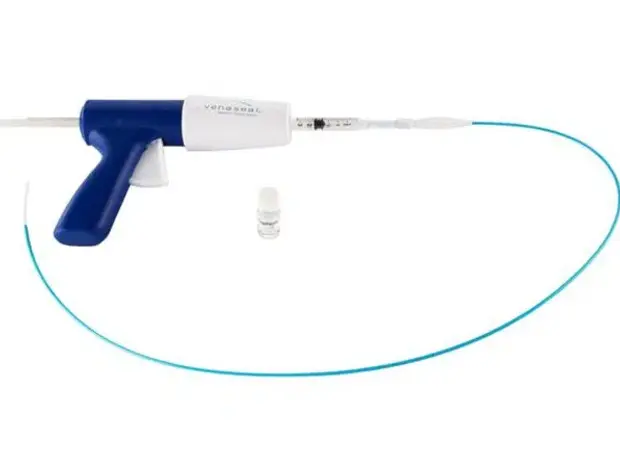
The aim of the procedure is to close the insufficient vein so that it no longer contributes to venous reflux. Once sealed, the blood is redirected towards other healthy veins, which then take over venous return from the leg.
The vein is not removed, as happens in classic surgery; instead, it is closed from within through a puncture and a catheter. Over time, the treated vein becomes a fibrous cord and may gradually reduce in size.
Why It Differs from Heat-Based Techniques
Radiofrequency and endovenous laser close the vein by applying controlled heat inside it. They are very useful techniques with extensive clinical experience, but precisely because they use heat, the tissues surrounding the vein need to be protected with tumescent anaesthesia.
VenaSeal® belongs to the group of non-thermal techniques. Instead of heating the vein wall, it releases small amounts of medical adhesive at specific points along the vein. This allows the vein to be sealed without infiltrating anaesthesia along its entire course.
For many patients, this is one of its main advantages: usually a single puncture, a very well-tolerated procedure, and immediate recovery. Even so, the choice between radiofrequency, laser, VenaSeal®, sclerotherapy or other options should not be based on theoretical preference, but on medical indication.
The Importance of Venous Duplex Ultrasound Before Deciding
Patients often ask directly about a specific technique during an appointment. However, the correct order is different: first we need to study the venous circulation, and only then decide which treatment makes the most sense.
Venous Duplex ultrasound allows us to see the course of the veins, check whether there is reflux, identify which segments are affected, and assess whether the anatomy is suitable for endovenous treatment with adhesive.
It also helps rule out situations in which a cautious approach is advisable, or another treatment should be chosen. Two patients may have varicose veins that look similar on visual examination and yet have completely different venous maps. That is why we do not treat photographs of legs: we treat individual people, each with their own anatomy and medical history.
How the Procedure Is Performed
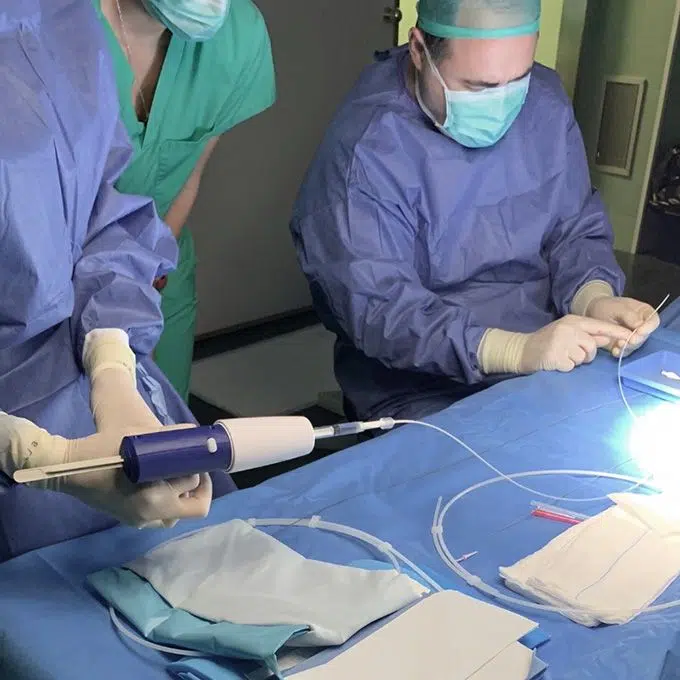
The procedure is performed through a puncture in the vein, under ultrasound guidance. Through that puncture, a fine catheter is introduced (very similar to inserting an intravenous line, in fact), and advanced inside the vein to the area to be treated.
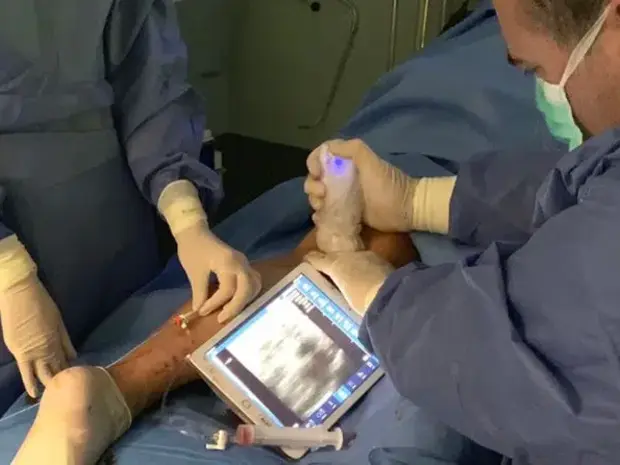
If the great saphenous vein is being treated, the catheter usually advances towards the groin area, always respecting safety distances. If the vein to be treated is the small saphenous vein, the route is planned towards the back of the knee. These details depend on each patient’s anatomy.
Once the catheter tip is in the correct position, small amounts of medical adhesive are released in a controlled way. External compression is applied to the vein at the same time to encourage sealing. The catheter is then gradually withdrawn until the planned segment has been completed.
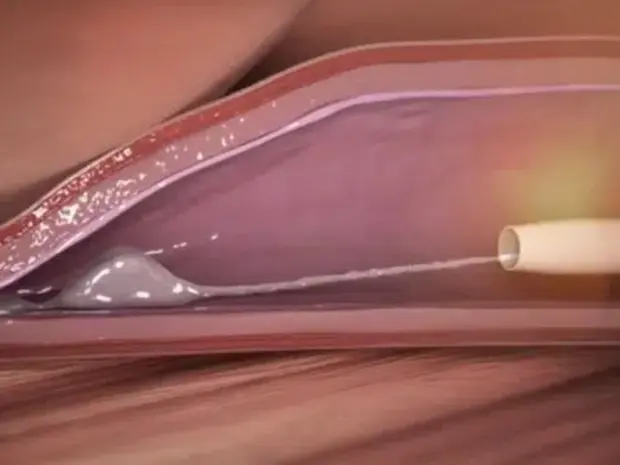
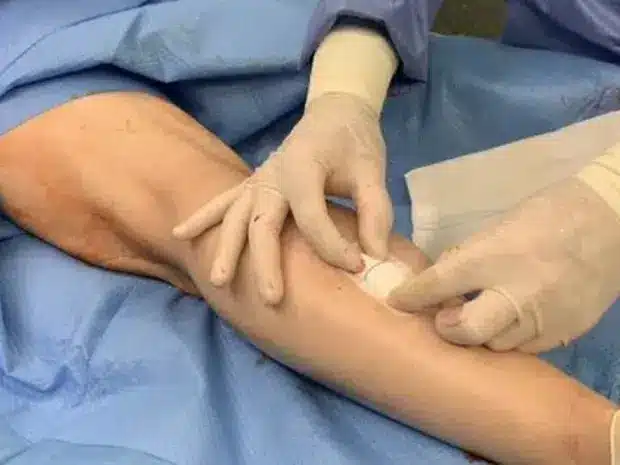
At the end, the catheter is removed and the puncture site is covered. No incisions are required, no stitches are needed, and the patient can stand up and walk immediately, following the instructions given at the appointment.
What Advantages It May Offer
When it is well indicated, VenaSeal® may offer several practical advantages for the patient.
- It is performed through a puncture and catheter, without the incisions used in classic surgery.
- It does not use heat, so it usually avoids tumescent anaesthesia along the entire vein: typically, only a single puncture for local anaesthesia is needed.
- It allows a quick recovery and an immediate return to normal activities.
- It does not require the subsequent use of a compression stocking.
- It can be especially comfortable for patients in whom reducing punctures or discomfort during the procedure is important.
These advantages do not mean that it is always the best option. They mean that, in suitable patients, it can be a very interesting tool within modern treatment for venous insufficiency.
What the Patient May Notice Afterwards
Recovery is usually very manageable. Many patients can walk from the very beginning and quickly return to everyday activities. Even so, recovery is not identical in every case.
During the first few days, there may be some tightness, sensitivity along the treated path, local discomfort, or mild inflammation. In the few cases in which this occurs, anti-inflammatory medication is prescribed, with improvement in 2–3 days.
It is also important to attend the scheduled follow-up visits. Follow-up allows us to check the progress of the treated vein, assess the clinical result, and decide whether any varicose branch or spider vein remains that should be treated with another complementary technique.
Is It Suitable for All Varicose Veins?
NO. This is one of the most important points in the article.
VenaSeal® is intended for the treatment of certain insufficient venous trunks, especially when the anatomy is suitable for advancing the catheter and sealing the vein safely. Not all varicose veins depend on a saphenous vein that can be treated with this technique, and not all patients have the same conditions.
Some varicose veins may require phlebectomy, sclerotherapy, radiofrequency, laser, conservative treatment, or a combination of procedures. In other cases, the prudent approach may be not to intervene at that time. The key is to personalise the decision.
VenaSeal® Compared with Other Treatments
There is no perfect technique for every patient. If several options continue to coexist in medicine, it is usually because each one has specific advantages, limits, and indications.
Classic surgery may still have a role in selected cases. Radiofrequency and laser have extensive experience behind them and good results in suitable veins. Sclerotherapy may be useful for certain types of veins and spider veins. VenaSeal® offers the advantage of not using heat and of simplifying recovery for many patients.
The question should not be “which is the most modern treatment?”, but rather “which treatment is most appropriate for my case?”. That answer can only be given after studying the venous system and calmly explaining the alternatives.
Is the Result Definitive?
When an insufficient vein is treated correctly, the aim is to close that diseased segment and improve the reflux that depended on it. However, chronic venous disease can evolve over the years.
Factors such as genetic predisposition, pregnancy, hormonal changes, ageing, excess weight, or certain sustained activities may favour the appearance of new varicose veins in the future. That is why absolute promises should be avoided.
It is more accurate to speak of treating the insufficient veins detected at that moment, with subsequent follow-up and preventive measures when indicated.
When VenaSeal® May Be Considered
It may make sense to consider VenaSeal® in patients with symptomatic varicose veins, proven venous reflux, and anatomy that is favourable for endovenous treatment with adhesive.
It may also be an interesting option when looking for a technique with quick recovery, without extensive tumescent anaesthesia, and with less need for compression afterwards. However, the final decision must take into account the type of vein affected, the extent of the disease, the patient’s medical history, and their expectations.
If you have varicose veins or symptoms of venous insufficiency, an assessment by a vascular surgeon makes it possible to study your case and decide whether VenaSeal® or another alternative may be the most reasonable option.
Conclusion
VenaSeal® is a modern technique for treating certain cases of venous insufficiency by closing the vein with a medical adhesive. Its main difference compared with thermal techniques is that it does not use heat, which may make the procedure simpler and more comfortable for many patients.
However, its real value does not lie in being a new technique, but in using it when it is well indicated. In varicose vein treatment, a good result always begins with an accurate diagnosis, a precise venous map, and an honest explanation of the available options.
General information. This article is for educational purposes and does not replace an individual medical consultation. Diagnosis and treatment must be decided after assessment by a qualified healthcare professional.
FREQUENTLY ASKED QUESTIONS
Is VenaSeal® suitable for all varicose veins?
NO. It is only suitable in certain cases of venous insufficiency, and always after studying the venous anatomy with Duplex ultrasound.
Is Duplex ultrasound needed before treatment?
YES, ALWAYS. Venous Duplex ultrasound makes it possible to locate the source of reflux, assess the course of the vein, and decide whether the technique is suitable.
Does VenaSeal® use heat?
NO. It is a non-thermal technique that closes the vein with a medical adhesive, unlike laser or radiofrequency.
Does it require anaesthesia?
Local anaesthesia is usually used at the puncture site, but tumescent anaesthesia along the entire vein is not usually required.
Do I need to wear a compression stocking afterwards?
In many cases it is not necessary, although the indication may vary depending on the patient, any combined technique, and the specialist’s criteria.
Is recovery immediate?
Usually, the patient can get off the treatment couch and walk out as soon as the procedure is finished.
Should you be interested in getting to know this disease better, and its causes, consequences, how to treat them, and, even better, what can we do to prevent them, you can find it all well explained in the ebook VARICOSE VEINS: Truth & myths.