

Leg swelling at the end of the day is a common concern, especially among people who spend many hours standing or sitting. However, not all swelling means the same thing. When the increase in volume clearly affects only one leg, or is much more pronounced in one leg than the other, it needs to be considered with a different degree of caution.
The aim of this article is not to encourage patients to diagnose themselves at home. Quite the opposite: it is intended to help clarify the situation, recognise when it is best not to wait and prepare for the appointment. Unilateral leg swelling may have a venous, lymphatic, traumatic or inflammatory cause, or may result from a combination of factors. This is why the context, clinical examination and, when appropriate, Duplex Ultrasound are so important.
Contents
- Why swelling in just one leg requires a different approach
- Possible causes: guidance without self-diagnosis
- Warning signs: when it is best not to wait
- When to seek prompt assessment and when to book a routine appointment
- What clinical examination and Duplex Ultrasound can show
- Information to prepare before your appointment
- A balanced guide: neither alarm nor complacency
- FREQUENTLY ASKED QUESTIONS
Why swelling in just one leg requires a different approach
Bilateral swelling, which affects both legs in a similar way, is often associated with general factors such as hormonal disorders, heat, a sedentary lifestyle, certain medicines, heart, kidney or liver problems, or venous insufficiency in both legs. We already have a specific guide to lower limb swelling that provides a broader overview.
Swelling in just one leg, by contrast, calls for a more localised assessment. Something may be affecting that particular limb: impaired venous return, thrombosis, inflammation, a muscle or joint injury, a skin infection, a lymphatic disorder or compression somewhere along the vascular pathway.
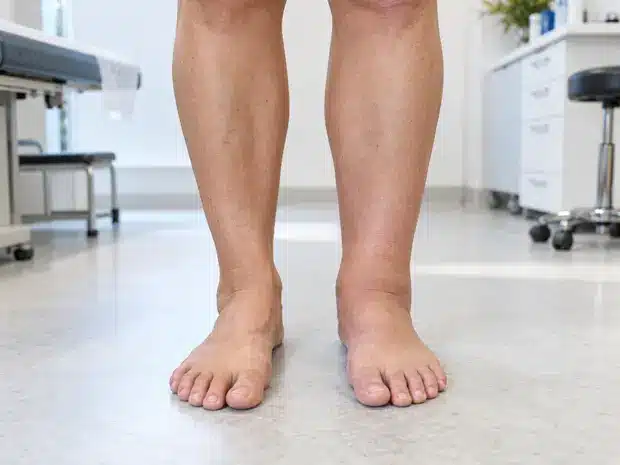
This certainly does not mean that every swollen leg is a serious emergency. It does mean, however, that it should not be dismissed simply as “poor circulation”. That phrase can be falsely reassuring and delay a necessary assessment. In vascular medicine, the details matter: when it started, how it has changed, whether it is painful or warm, whether the skin colour has changed, and whether there has been a long journey, recent surgery or an injury.
Possible causes: guidance without self-diagnosis
A leg can become swollen for many different reasons. At the clinic, we do not begin with a fixed label but with a reasoned list of possibilities, which is narrowed down through examination and the appropriate tests. This is the differential diagnosis: it is not about guessing, but about systematically ruling out conditions that may be important.
Among the venous causes, one that must always be considered is deep vein thrombosis. It may cause swelling, pain, tightness in the calf or thigh, local warmth or discomfort when walking, although it does not always present so typically. Problems can also affect the superficial venous system, including significant varicose veins, superficial phlebitis or venous insufficiency that is more pronounced in one leg than the other.
Lymphatic causes are also common. Lymphoedema occurs when lymphatic drainage is impaired and fluid builds up in the tissues. It may predominantly affect one leg and tends to be more persistent. Our blog explains in more detail what lymphoedema is and when to seek medical advice.
There are traumatic and inflammatory causes as well. A sprain, muscle tear, haematoma, joint inflammation, knee or ankle injury, or skin infection can all cause a leg to swell. Sometimes the patient clearly remembers the trigger; in other cases, they simply notice that the leg has been different since a particular day. This is why it is not advisable to attribute everything to the veins without considering the full picture.
Warning signs: when it is best not to wait
Some situations require prompt medical assessment. This does not always mean rushing to seek care without considering the circumstances, but it does mean contacting a healthcare service rather than waiting several days “to see if it goes away”. Caution is particularly important here because some causes require early treatment.
- Swelling that appears suddenly in one leg, especially if it increases over a few hours or within one or two days.
- Severe pain, marked tightness, difficulty bearing weight or walking, or unexplained pain in the calf or thigh.
- Warmth, redness, hardening of the skin or a tender cord along the path of a superficial vein.
- Shortness of breath, chest pain, coughing up blood, severe dizziness or fainting together with a swollen leg. In this situation, assessment must be urgent.
- Fever, feeling generally unwell, very red skin or a wound that is getting worse.
- Recent surgery, immobilisation, a plaster cast, hospital admission, active cancer, pregnancy, the postpartum period, hormone treatment or a long journey.
It is important to emphasise that these signs do not provide a diagnosis on their own. A warm, painful leg can have several causes. They do, however, indicate that the situation needs prompt assessment to rule out problems that should not be left unchecked.
When to seek prompt assessment and when to book a routine appointment
The degree of urgency depends on how the swelling began, its severity and the presence of risk factors. If it is new, clearly affects one leg, is painful, or is accompanied by warmth, redness or difficulty walking, you should seek prompt medical assessment. If respiratory symptoms or chest pain also occur, assessment must be urgent.
Swelling that appears after a long journey also needs early assessment. Sitting for many hours reduces the action of the calf muscles, which act as a pump to help return blood to the heart. In people who are predisposed, this slowing of blood flow can contribute to venous problems. We discuss this further in our guide to travel and circulation.

If, on the other hand, the swelling has been present for months or years, progresses slowly, is not associated with significant pain or sudden changes, and is related to known varicose veins or suspected lymphoedema, a routine appointment with a specialist can be arranged. Routine does not mean unnecessary: it means the problem can be assessed carefully, the extent of the swelling measured, the skin examined, the medical history reviewed and any necessary tests or treatment considered.
A common mistake is to treat every case in the same way. Not all unilateral swelling is a thrombosis, and not all chronic swelling is unimportant. The key is not to delay assessment of sudden or painful swelling or swelling accompanied by warning signs, and not to accept persistent swelling without a proper diagnosis.
What clinical examination and Duplex Ultrasound can show
Clinical examination remains the first step. The doctor compares both legs, checks whether pressing the swelling leaves an indentation, assesses skin temperature and colour, and looks for localised pain, varicose veins, skin changes, wounds, signs of infection, an increased circumference and the distribution of the swelling. Swelling that begins at the ankle is not the same as an entire leg that has increased in volume, just as soft swelling at the end of the day is not the same as painful tightness of recent onset.
A venous Duplex Ultrasound examines the veins non-invasively. It combines ultrasound imaging with blood-flow analysis and helps assess whether the deep veins are patent, investigate suspected thrombosis, identify superficial venous insufficiency, determine which veins are affected and show how blood flows through each segment. In expert hands, it is not simply a “picture” of the leg; it provides a functional map of venous return.
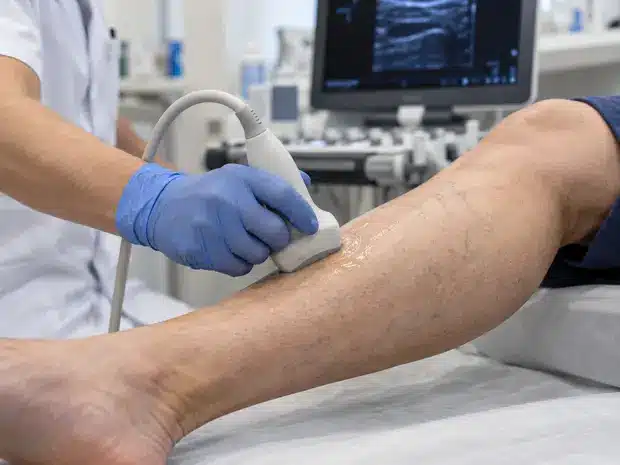
However, Duplex Ultrasound does not replace clinical judgement and cannot explain every case of swelling. It can provide very useful information about venous causes, but if the problem appears to be lymphatic, joint-related, muscular, infectious or due to another cause, further investigation or referral to the appropriate professional may be needed. A normal test should not automatically be taken to mean that “nothing is wrong”; it must be interpreted in the context of the full medical history.
Information to prepare before your appointment
A vascular appointment is much more useful when the patient can clearly describe how the problem has developed. There is no need to bring a perfect report, but a few simple details can help determine whether the problem seems recent or chronic, and whether it may be venous, lymphatic, traumatic or inflammatory.

- When the swelling started and whether it appeared suddenly or gradually.
- Whether it affects the foot, ankle, calf, thigh or the whole leg.
- Whether it changes during the day, improves when the leg is elevated or worsens while standing.
- Whether there is pain, warmth, redness, heaviness, tingling, wounds or skin changes.
- Whether there has been an injury, physical overexertion, surgery, immobilisation, a long journey, hospital admission or a recent infection.
- Current medicines, especially hormone treatments, anticoagulants, anti-inflammatory medicines or drugs that may contribute to swelling.
- A history of varicose veins, thrombosis, phlebitis, lymphoedema, cancer, recent pregnancy or similar episodes.
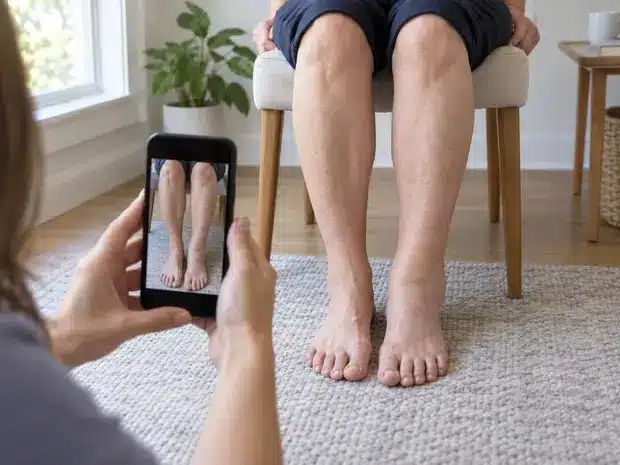
It may be helpful to bring photographs if the swelling changes considerably during the day. Take them in good light and include both legs for comparison. It can also help to note whether the circumference of one calf has increased compared with the other, although a measurement taken at home never replaces a medical assessment.
A balanced guide: neither alarm nor complacency
Unilateral leg swelling is a symptom that calls for balance. Becoming alarmed by every slight difference can create unnecessary anxiety, but dismissing it from the outset can also be dangerous. The sensible approach is to observe the pattern, recognise the warning signs and seek medical advice sooner when the onset is sudden or painful or when risk factors are present.
At Clínica Vascular Dr. Jorge Molina, we take a thorough approach to this type of concern: medical history, physical examination, vascular assessment and Duplex Ultrasound when indicated. The aim is not to apply a quick label, but to rule out urgent problems, understand the most likely cause and propose a plan tailored to the individual case.
A swollen leg should not be interpreted in isolation from its context. The important question is not only how much it has swollen, but how and when it developed and what other features accompany it.
FREQUENTLY ASKED QUESTIONS
Does a swollen leg always mean thrombosis?
NO. Deep vein thrombosis is one possibility that must be ruled out in certain circumstances, but there are also superficial venous, lymphatic, traumatic, joint, muscular and inflammatory causes. This is why the whole clinical picture must be assessed.
Can I wait a few days if only one leg is swollen?
It depends. If the swelling is sudden, painful, increasing quickly, accompanied by warmth or redness, or if there are recent risk factors such as surgery, immobilisation or a long journey, you should seek prompt medical assessment.
Can Duplex Ultrasound identify the cause?
Duplex Ultrasound is very useful for examining the venous system and ruling out or confirming problems such as thrombosis or venous insufficiency. Even so, it must be interpreted alongside the clinical examination, because not all swelling is venous in origin.
Should I wear a compression stocking before seeking medical advice?
There is no single answer for everyone. Compression stockings can be useful for many venous or lymphatic problems, but the type of compression must be tailored to the diagnosis and the patient. If there is sudden pain, warmth or suspected thrombosis, seek medical advice first.

Should you be interested in getting to know this disease better, and its causes, consequences, how to treat them, and, even better, what can we do to prevent them, you can find it all well explained in the ebook VARICOSE VEINS: Truth & myths.