

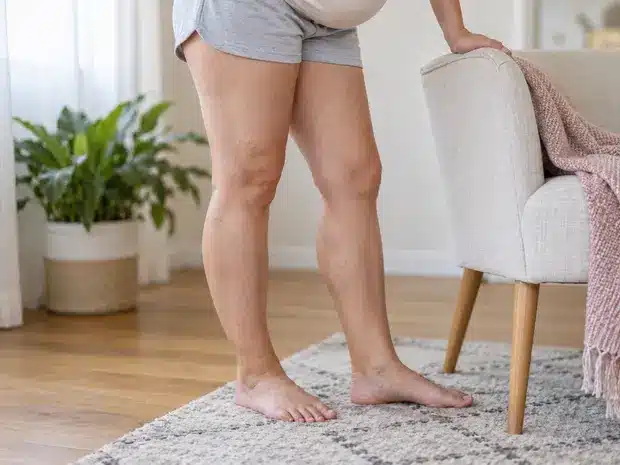
During pregnancy, veins may become more visible, spider veins or true varicose veins may develop, and existing varicose veins may enlarge. This is a common and understandable concern: in addition to the cosmetic change, some women experience heaviness, pain, itching or swelling by the end of the day.
There is no single explanation involving just one hormone or only the pressure of the uterus. Pregnancy brings together hormonal, circulatory and mechanical changes that make it harder for blood to return from the legs. The good news is that many of these changes lessen after childbirth. Even so, they do not all disappear, so it is helpful to know which measures can help, which treatments are usually postponed and which symptoms should not simply be attributed to pregnancy.
Contents
- Why do varicose veins develop during pregnancy?
- Who is more likely to develop them?
- What can you do to relieve symptoms?
- Medication and treatments: what is usually postponed?
- When to seek medical advice and when to go to the emergency department
- Vulvar varicose veins: striking, but not always dangerous
- Will they disappear after childbirth?
- Varicose veins before a future pregnancy
- FREQUENTLY ASKED QUESTIONS
Why do varicose veins develop during pregnancy?
The veins in the legs have to return blood to the heart against gravity. To do this, they contain valves that prevent blood from flowing backwards and rely on contraction of the calf muscles, which act as a pump whenever we walk.
During pregnancy, circulating blood volume increases and the vein walls become more distensible. Hormones, although not the only cause, play an important part in this process, particularly progesterone, which is also the predominant hormone during the final months of pregnancy. As the uterus grows, pressure within the abdomen also increases and may hinder venous return from the pelvis and legs. If there is also a family predisposition or pre-existing venous insufficiency, the superficial veins are more likely to dilate.
Duplex ultrasound studies performed throughout pregnancy have shown that some veins increase in diameter as pregnancy progresses and that temporary venous reflux may develop. Some of these changes lessen after childbirth. This explains why an examination performed late in pregnancy does not always reflect the final state of the veins.
Who is more likely to develop them?
Pregnancy is a genuine risk factor, but it does not affect every woman in the same way. Evidence indicates that the risk increases with the number of pregnancies. Age, family history and having varicose veins before pregnancy also play a part.
- Family history of varicose veins or venous insufficiency.
- Varicose veins, swelling or venous reflux before pregnancy.
- Several previous pregnancies.
- Older maternal age.
- Obesity or pregnancy weight gain above the range recommended by the obstetric team.
- Prolonged periods of immobility.
Having one or more of these factors does not mean that varicose veins will necessarily develop. Likewise, a woman with no previous history may develop them for the first time during pregnancy. It is therefore more helpful to talk about probability than inevitable causes.
What can you do to relieve symptoms?
Treatment during pregnancy is usually conservative. The aim is to reduce heaviness, pain and swelling, maintain mobility and watch for possible complications while waiting to see how the condition evolves after childbirth.
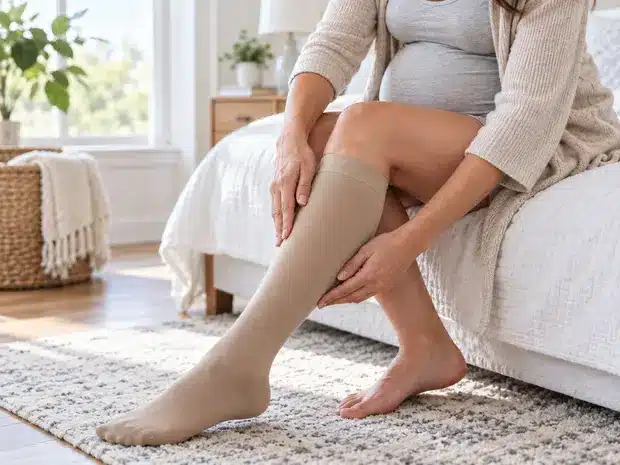
Compression stockings are the best-studied measure. They may improve symptoms and swelling and may help limit some changes in venous reflux. However, they have not consistently been shown to prevent new visible varicose veins from developing. To be effective, they must have the correct size, length and compression level; not every stocking is suitable for every patient.
- Walk and remain physically active in a way that is compatible with your obstetrician’s advice.
- Avoid spending many hours sitting or standing without moving your legs.
- Flex and extend your ankles when you need to remain seated for a long period.
- Rest with your legs elevated if you experience heaviness or swelling.
- Manage weight gain in line with your obstetric team’s recommendations, without starting diets or restrictions on your own.
- Avoid intense heat if you notice that it worsens your symptoms.
These measures support venous return and often improve comfort, but they cannot guarantee that varicose veins will not develop. Individual predisposition and the changes associated with pregnancy cannot always be modified.

Medication and treatments: what is usually postponed?
Medicines known as venotonics or phlebotonics should not be taken without medical advice. Although some small studies have reported symptom improvement with certain products, the available data do not allow their benefits and fetal safety during pregnancy to be assessed with sufficient confidence. Any medication, including herbal products, should be discussed with the obstetrician.
Sclerotherapy, endovenous laser treatment, radiofrequency ablation and other procedures intended to remove varicose veins are elective treatments and are generally postponed until after pregnancy. This is not because all these techniques have been shown to cause fetal harm, but because there is insufficient evidence to justify their routine use, conservative alternatives are available and some varicose veins may improve spontaneously after childbirth.
For the same reason, there is no benefit in treating spider veins for cosmetic purposes during pregnancy. In our article about sclerotherapy, we explain in more detail why this treatment should be postponed during pregnancy. Exceptional circumstances must be assessed individually by the medical team.
When to seek medical advice and when to go to the emergency department
Swelling in both legs, particularly at the end of the day, is common during pregnancy and does not in itself mean that there is a thrombosis. The important point is not to dismiss symptoms that begin suddenly, are clearly one-sided or are accompanied by localised pain.
Seek medical assessment without delay if you notice any of the following:
- Sudden swelling in one leg that is clearly greater than in the other.
- Severe or newly developed pain in the calf or thigh.
- A painful, hard, red or warm vein.
- A rapid and marked increase in varicose veins.
- Bleeding from a varicose vein.
- Very large, painful or bleeding vulvar varicose veins.
If you develop sudden shortness of breath, chest pain, coughing up blood, severe dizziness or loss of consciousness, go to the emergency department immediately. These symptoms may be caused by a pulmonary embolism and should not wait for a scheduled appointment. You can find more information in our article about Deep Vein Thrombosis.
A venous Duplex Ultrasound is a non-invasive test that is particularly useful when there is swelling in one leg, localised pain, suspected thrombosis, rapidly developing varicose veins or complex venous disease. It provides all the information we need about the current state of your venous systems.
Vulvar varicose veins: striking, but not always dangerous
Some pregnant women develop dilated veins in the vulva or perineum. These may cause pressure, heaviness, discomfort while standing or concern about their appearance. They are more common after several pregnancies and may be related to changes in pelvic venous flow.
Many improve considerably after childbirth. If they are extensive, a combined assessment is advisable and may include a clinical examination, Duplex Ultrasound, gynaecological ultrasound and obstetric planning. Vulvar varicose veins, even when large, are not in themselves an automatic indication for a caesarean section. The mode of delivery should be decided according to the obstetric situation, the precise location of the varicose veins, their vaginal extent and the individual risk of bleeding.
If they persist for months after childbirth, are accompanied by chronic pelvic pain or appear in unusual locations on the thigh or perineum, it may be necessary to investigate a possible pelvic venous origin.
Will they disappear after childbirth?
Many varicose veins and spider veins become less visible during the first weeks and months after childbirth as circulating blood volume falls, pressure from the uterus resolves and venous tone recovers. Swelling and some reflux that developed during pregnancy may also lessen.
There is no universal percentage of varicose veins that will disappear. They are more likely to persist if they were present before pregnancy, there is a family history, the woman has had several pregnancies or there is structural venous insufficiency. It is therefore unwise to promise that they will all disappear or to decide on definitive treatment too soon.
In an uncomplicated situation, it is usually reasonable to wait 6–8 weeks after childbirth and reassess once the venous system has stabilised. Much of the remodelling takes place during this period, although this timeframe is a guide rather than a rigid cut-off. If varicose veins or symptoms persist, a Duplex Ultrasound can show which reflux remains and help select the appropriate treatment.
Varicose veins before a future pregnancy
There is no single rule that applies to every woman. A subsequent pregnancy may promote the development of new varicose veins or the recurrence of previously treated disease, but this does not mean that every woman must wait until she has completed her family before receiving treatment.
If there are significant symptoms before pregnancy, episodes of superficial thrombophlebitis, skin changes or clinically important venous reflux, investigating and treating the condition may be reasonable. The decision depends on the anatomy, severity of symptoms, how soon pregnancy is planned and the patient’s preferences. The important point is to explain clearly that no procedure makes the veins immune to the effects of a future pregnancy.
In summary: varicose veins during pregnancy are usually managed with conservative measures and monitoring. Many improve after childbirth, but not all. An individual vascular assessment can help relieve symptoms, identify complications promptly and determine the right time to investigate or treat any problems that persist.
FREQUENTLY ASKED QUESTIONS
Are varicose veins dangerous during pregnancy?
Most mainly cause discomfort or cosmetic concern. However, a very painful and hardened vein, sudden swelling in one leg, bleeding or respiratory symptoms require urgent medical assessment to rule out complications.
Do compression stockings prevent varicose veins from developing?
They greatly reduce their occurrence, although it has not been possible to demonstrate that they prevent them completely. They may also relieve heaviness, pain and swelling and improve some aspects of venous return when properly prescribed and fitted.
Can I have sclerotherapy while pregnant?
Elective sclerotherapy is usually postponed until after pregnancy. There is insufficient evidence about fetal safety, the expected benefit can usually wait and some visible veins may improve after childbirth.
When should varicose veins be reviewed after childbirth?
If there are no complications, it is usually reasonable to wait 6–8 weeks after childbirth for the venous system to stabilise. By then, much of the remodelling has already taken place and it is possible to obtain a more “definitive” picture of the state of the venous systems.
Do vulvar varicose veins mean that a caesarean section is necessary?
No. On their own, they are not an automatic indication for a caesarean section. The mode of delivery should be decided according to the obstetric situation, the extent and location of the varicose veins and the individual risk of bleeding.
Should you be interested in getting to know this disease better, and its causes, consequences, how to treat them, and, even better, what can we do to prevent them, you can find it all well explained in the ebook VARICOSE VEINS: Truth & myths.