

After the summer, many people look at their legs again with an idea they have been putting off for months: “this year I really am going to do something about my varicose veins.” Autumn is indeed a very good time to start. Temperatures fall, routines return, and there are still several months before legs are on show again.
However, it is important to explain what “a good time” actually means. Varicose veins do not respond better simply because the leaves are falling, nor do modern treatments stop working when the weather is hot. The advantages of autumn are mainly practical: some aftercare measures are easier to tolerate, temporary marks remain covered, and treatment can be planned calmly.
In this article, I will explain what we really know, which treatments may benefit most from the cooler months, and why every decision should begin with an individual diagnosis.
Contents
- Is autumn really better for treating varicose veins?
- The practical advantages of starting in autumn
- The plan starts with a diagnosis, not a technique
- Which treatments fit best into the cooler months?
- When you should not wait until autumn
- How to plan your treatment starting this autumn
- FREQUENTLY ASKED QUESTIONS
Is autumn really better for treating varicose veins?
The short answer is that autumn is often more comfortable, but it has not been shown to be a biologically safer or more effective season. The main international guidelines on venous disease do not recommend a particular time of year for treating varicose veins.
The most direct evidence comes from a study published in 2023 that analysed 846 endovenous thermal ablation procedures (laser/radiofrequency). It compared procedures performed at temperatures below 25 °C, between 25 and 29.9 °C, and at 30 °C or above. Occlusion rates were excellent, at 99–100%, with no significant differences in satisfaction, time off work, bleeding, or thromboembolic events.
This helps us separate two ideas that are often confused: heat can increase feelings of heaviness or swelling in some people, but this does not mean that treatment performed in summer will work less well. It is therefore reasonable to describe autumn as a good time for treatment; it would not be reasonable to present it as the only safe time.
The practical advantages of starting in autumn
If treatment is elective and we can choose the date, autumn provides several conditions that can make the experience easier for the patient:
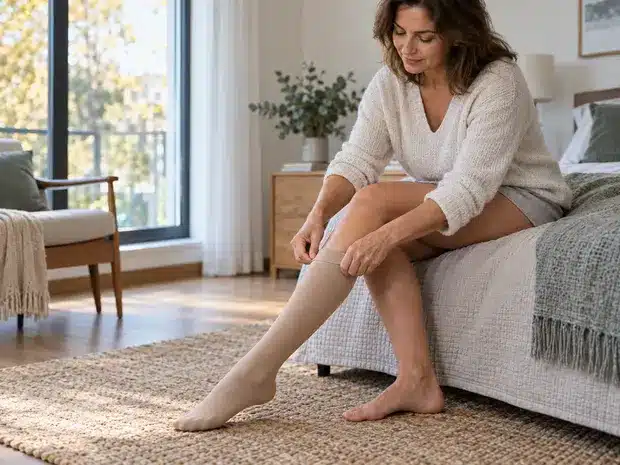
- Compression is easier to tolerate. When compression stockings are prescribed for a few days or weeks, they are usually easier to wear in milder temperatures.
- Legs are less exposed. Small bruises, local swelling, or temporary pigmentation can remain covered by everyday clothing.
- There is more time for the results to develop. Some treatments, particularly sclerotherapy, require several sessions and do not produce immediate results.
- Routines are more settled. There is less disruption from holidays, the beach, swimming pools, and long trips, and it is usually easier to attend follow-up appointments.
- Planning ahead for the following summer. Starting in September, October, or November allows time for diagnosis, treatment, and follow-up without rushing.
Compression deserves some clarification. Current studies indicate that, after thermal ablation, its main benefit is a modest reduction in early pain. In practice, however, it remains relevant in certain protocols, in sclerotherapy, and when extensive phlebectomies are performed. This is where cooler weather can make a real difference to comfort and adherence.
It is also sensible to limit sun exposure on inflamed or pigmented areas after certain procedures, especially after sclerotherapy: having this treatment during the summer may increase the risk and severity of side effects such as hyperpigmentation.
The plan starts with a diagnosis, not a technique
Two legs with varicose veins that look similar can have very different circulatory problems. This is why we should not choose between laser, foam, phlebectomy, or medical adhesive based only on a photograph, an advertisement, or the time of year.
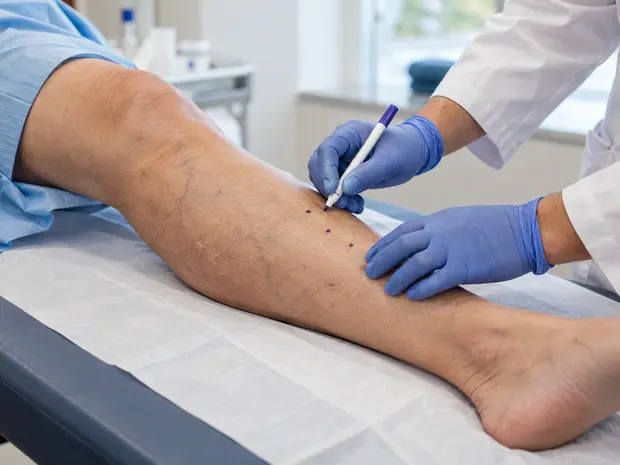
The first step is a clinical assessment and, when indicated, a venous Duplex Ultrasound. This examination shows the direction of blood flow, locates the source of reflux, and identifies which veins are affected. With this map, we can decide whether conservative measures are enough, whether a saphenous vein should be treated, whether the problem is limited to small superficial veins, or whether there is another cause for the symptoms.
The aim is not to “remove everything we can see,” but to treat what is diseased while preserving veins that are functioning properly. The technique must be adapted to the patient, never the other way around.

Which treatments fit best into the cooler months?
Sclerotherapy for spider veins and small superficial veins. This is probably the situation in which a preference for autumn and winter is clearest. Treatment may require several sessions, compression depending on the case, and time for small bruises, inflammation, or pigmentation to fade. Anyone hoping to improve the appearance of their legs for the following summer gains valuable time by starting in autumn. In this article about sclerotherapy, we explain its possibilities and limitations in detail.
Ambulatory phlebectomies. When several varicose segments need to be removed through tiny incisions, bruising and local tenderness may occur. Autumn clothing makes these marks easier to conceal, and compression stockings are usually better tolerated.
Endovenous laser and radiofrequency. These are highly effective minimally invasive techniques for certain types of saphenous vein reflux. They can be performed throughout the year; autumn offers practical convenience, but not greater effectiveness. You can find more information in our article on laser and radiofrequency.
Non-thermal techniques. In some patients, options such as medical adhesive may be considered and, depending on the protocol, may reduce or avoid the need for compression. This makes the season less important, but it does not mean the technique is suitable for everyone. We explain this procedure in our article about VenaSeal®.
Ultimately, the best treatment depends on the type of vein, the anatomy, the symptoms, the patient’s medical history, and their reasonable preferences. The calendar is one factor, but it is not the deciding one.
When you should not wait until autumn
The fact that autumn is more comfortable does not mean that a necessary consultation should be delayed. When there is a medical indication, modern treatment can be arranged at any time of year. Waiting several months solely because of the calendar may make little sense for patients with advanced venous disease or complications.
You should seek medical advice promptly if a varicose vein bleeds, if there is a painful, hardened area consistent with superficial phlebitis, a wound or ulcer that does not heal, significant skin changes, or rapidly worsening swelling. Sudden swelling in one leg, with or without pain, requires URGENT medical assessment.
There is another common situation: people whose symptoms are worse in summer because of the heat. Several studies confirm that a substantial proportion of patients experience more heaviness, pain, or swelling at high temperatures. In this situation, worsening symptoms in summer may be a reason to seek advice sooner, rather than putting up with them until a particular date arrives.

How to plan your treatment starting this autumn
If you have been thinking about treating your varicose veins for some time, you can use the change of season to follow a simple plan:
- Arrange a vascular assessment. Explain which symptoms you have, how long you have had them, and what you hope to achieve.
- Have the necessary tests. A venous Duplex Ultrasound identifies the source of the problem and prevents treatment from being carried out without a proper diagnosis.
- Review the options. Ask which technique is being proposed, why it is recommended, how many sessions you may need, and what role compression will play.
- Allow time for recovery and results. Small marks and areas of pigmentation can take weeks or months to fade.
- Plan your follow-up appointments. Follow-up is part of the treatment and allows your progress to be checked.
Autumn is not a magic word, but it is a very sensible opportunity to stop putting the problem off. With more comfortable temperatures and several months ahead, it is easier to complete the assessment, choose the right technique, and reach the following summer with the treatment and recovery already well advanced.
This is particularly relevant for SCLEROTHERAPY, because starting in autumn gives us enough time to complete the treatment and subsequent recovery before the following summer arrives.
My advice is simple: do not choose a technique because of the season, and do not wait for a season out of habit. Start by finding out what is happening in your veins. From there, we can decide together which timing and treatment best suit your individual case.

FREQUENTLY ASKED QUESTIONS
Are varicose veins better treated in autumn than in summer?
Treatments have not been shown to be more effective or safer simply because they are performed in autumn. The cooler months are more comfortable for wearing compression, concealing temporary marks, and completing several sessions before summer.
Is autumn better for sclerotherapy of spider veins?
YES. Starting this treatment in autumn offers several advantages: the next summer is still a long way off, which reduces the likelihood of permanent pigmentation; there is time to complete enough sessions to achieve the best possible result; and wearing the compression stockings required during the following weeks is more manageable.
Can I have my varicose veins treated in hot weather?
YES. Modern techniques (Radiofrequency, VenaSeal®) can be performed throughout the year when indicated. The timing is adapted to the type of treatment, your circumstances, and the specialist’s recommendations.
When will I start to see the results?
It depends on the technique and the type of vein. Functional improvement occurs early after some procedures, but bruising, local inflammation, or pigmentation may take weeks or months to resolve.
Will I need to wear compression stockings?
Not always, and not for the same length of time. The need for compression varies according to the technique, the extent of treatment, and the protocol recommended for each patient.
Which test do I need before having varicose veins treated?
A clinical assessment is essential and is often complemented by a venous Duplex Ultrasound. This test identifies the source of reflux and allows treatment to be tailored to the anatomy and the underlying problem.
Should you be interested in getting to know this disease better, and its causes, consequences, how to treat them, and, even better, what can we do to prevent them, you can find it all well explained in the ebook VARICOSE VEINS: Truth & myths.